
![‘100 Nights of Hero’: A Fantastical Feminist Fairytale [Review]](https://www.thathashtagshow.com/wp-content/uploads/2025/12/6d417c88-5897-4bc3-8600-a0f18b66c56a-1280x640.jpg)
Julia Jackman’s delightful fairytale romance is a balm during a time when women are facing increased resistance regarding their own choices. 100 Nights Of Hero takes you into a colorful world where women can make choices. It is a love story and a reminder of the resilience and strength women can possess.
Based on the book by Isabel Greenberg, 100 Nights of Hero is a larger story comprised of smaller stories. Following Hero (Emma Corrin) and Cherry (Maika Monroe). Cherry, the kind of gentle maiden these fairytales are suited for, faces pressure from in-laws and the bird-worshipping religious order to produce a child. However, her husband Jerome (Amie El-Masry) actively avoids going to bed with her, forcing her to accept all the blame for failing to do so.
When Jerome leaves Cherry with a handsome stranger named Manfred (Nicholas Galitzine), it is as a bet that she will not cheat on him. Manfred, however, is almost relentlessly flirtatious. Because of this, Cherry asks Hero to tell a story every time Manfred’s advances become too much for her. Hero then begins telling the story of Rosa (Charli XCX) and her sisters while Cherry desperately seeks a way out.
Parallels, Patriarchy, And Queerness
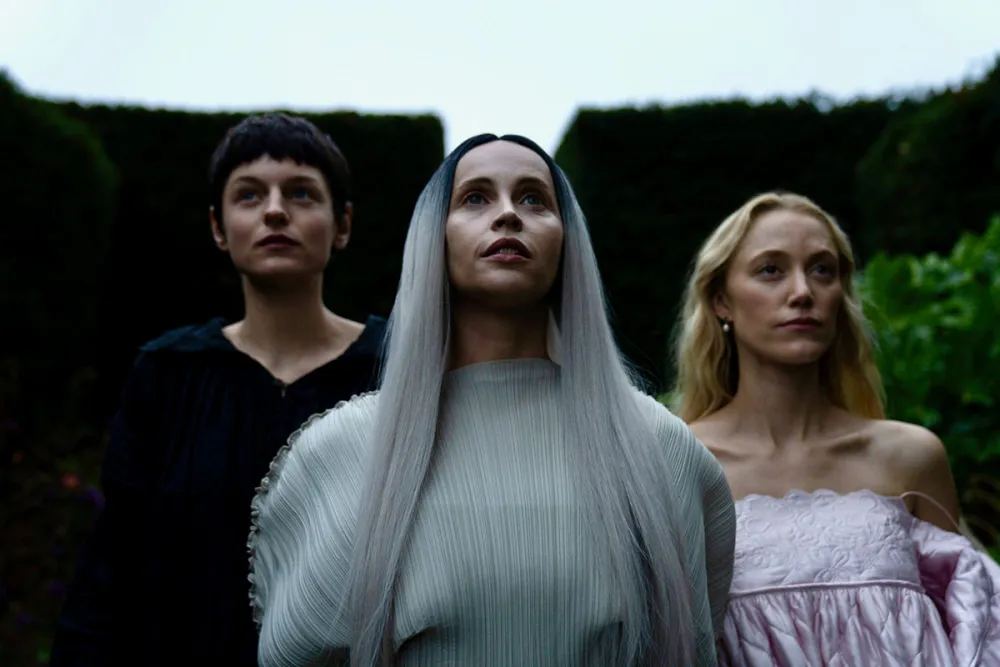
The story of Rosa and her sisters, who are persecuted for reading and writing, exists almost like a mirror to Cherry’s story. Jerome, like those in Rosa’s world who are terrified of women being able to learn and be independent, fears being unable to control Cherry. The bet involving Manfred is evidence of that: No man comfortable with his own masculinity would ever wager such a thing.
100 Nights of Hero does what fairytales have been doing for centuries: Offering us a glimpse of our own world through a more fantastical, supernatural lens. Cherry is using Hero’s story as a literal escape, finding solace in the dreamy, saturated scenery of Rosa’s world.
There is no mistaking the heavy emphasis on the patriarchy, nor the fixation on fertility and ownership. Abortion rights have become even more debatable in recent years as society threatens to force women back. Jackman keeps a spotlight on those issues throughout both stories.
The romance that builds between Cherry and Hero is simple and quiet. Its queerness is not understated so much as it is somewhat chaste, with the sense that Hero is something akin to a knight in shining armor trying to rescue a princess from her entrapment. Hero very clearly cares deeply for Cherry, keeping as watchful an eye on her as a sentinel.
The fairytale world often evokes Tarsem Singh’s “The Fall,” with its saturated colors and costumes. Cinematographer Xenia Patricia, production designer Sofia Saccomani, art director Naomi Bailey, and costume designer Susie Coulthard all dove deep into creating a world you’d want to be tipped headfirst into, setting the scene with elaborate costumes and dreamy lighting.
Jackman created something incredibly special at an incredibly difficult time. 100 Nights of Hero soothes your soul, gives you hope, and reminds you to keep sharing women’s stories, always.
For more Reviews, make sure to check back to That Hashtag Show.



![Transformers: Rise of the Beasts – Optimus Gets Savage [Review]](https://www.thathashtagshow.com/wp-content/uploads/2023/06/344930536_235314805892502_8946967532549828585_n-440x264.jpg)

 That Hashtag Show
