
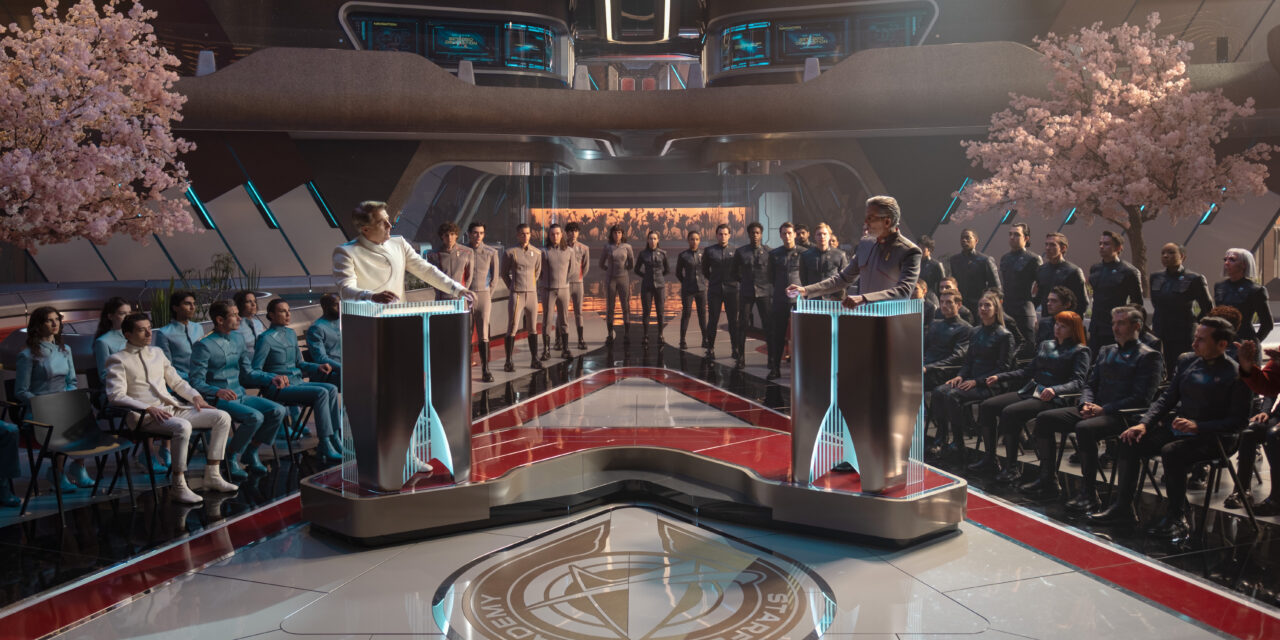
Star Trek: Starfleet Academy will end after its second season when it airs on Paramount+. The show was originally picked up on the streamer and renewed for a second season before the first had aired. The first season debuted in January 2025 and aired its season finale on March 12. The second season wrapped up production recently.
Here’s what Paramount+ and CBS Studios had to say in a joint statement about the series.
“We’re incredibly proud of the ambition, passion, and creativity that went into bringing ‘Star Trek: Starfleet Academy’ to life. The series introduced audiences to a bold new group of characters, welcomed familiar faces, and expanded the ‘Star Trek’ universe in exciting new ways. We’re grateful to Alex Kurtzman, Noga Landau, Gaia Violo, and the entire cast and crew who pushed storytelling boundaries in the spirit of Gene Roddenberry’s vision. We look forward to sharing the upcoming second and final season with everyone, and continuing to celebrate the cast, crew, and all that was accomplished with this series.”
The first season of the series was well regarded by critics and kicked off after the events of Star Trek: Discovery in the 32nd century. The show follows a new class of students and teachers to attend the newly re-established Starfleet Academy. The show starred Sandro Rosta, Karim Diané, Kerrice Brooks, George Hawkins, Bella Shepard, and Zoë Steiner, as well as Holly Hunter, Paul Giamatti, Gina Yashere, Star Trek Voyager alum Robert Picardo, and Discovery star Tig Notaro. Tatiana Maslany appeared in a guest role.
The co-showrunners and executive producers of the series Alex Kurtzman and Noga Landau penned a letter for the fans of the series.
The Letter From Kurtzman And Landau To Star Trek: Starfleet Academy Fans

It’s been my and Noga’s joy and privilege to help carry Gene Roddenberry’s extraordinary vision forward with Starfleet Academy, thanks to the hundreds of hardworking humans who pour every ounce of their talents into the work daily with imagination and reverence. We are in post-production now on what will be the second and final season. We’re so proud of what we’ve accomplished together on this show, and the world will get to see the work of these extraordinary artists when season two airs. We will finish strong.
Whether you’re working on Star Trek or part of the marvel that is Star Trek fandom — its very heart, soul, and conscience —the joy comes from adventuring across boundaries of time, space, and the humanly possible in service to Roddenberry’s transformative vision of the future. That incomparable vision was fueled by an inexhaustible optimism. Star Trek places its bet on the best in human nature. It dares to imagine a society of “infinite diversity in infinite combinations,” free of war, hate, poverty, disease, and repression, and dedicated to the spirit of scientific inquiry and respect for all life, whether carbon or silicon-based, green-skinned or blue.
But make no mistake: Gene Roddenberry wasn’t some starry-eyed dreamer. He was a decorated Army bomber pilot in the Pacific Theater. He had seen first-hand the grim consequences of the worst of human nature. And his vision of the future wasn’t just a promise of hope. It was also a warning. In a fraught, frightening time of intolerance and violence, Star Trek said: Look! We made it! But just barely. First, we had to put all those ancient scourges behind us. It said that what makes us glorious as a species, and gives us hope for the future and the galaxy is inextricably linked to what makes us dangerous to each other, to this one world we presently inhabit, and to ourselves. That dual message—of hope and of warning—isn’t just a pretty dream but a call to action, to think about who we are in a different way.
Please don’t take our word for it. Take Gene’s:
“Star Trek was an attempt to say that humanity will reach maturity and wisdom on the day that it begins not just to tolerate, but take a special delight in differences in ideas and differences in life forms. […] If we cannot learn to actually enjoy those small differences, to take a positive delight in those small differences between our own kind, here on this planet, then we do not deserve to go out into space and meet the diversity that is almost certainly out there.”
With enduring hope that his vision of the future is possible, for our children, their children, and every future cadet in Starfleet Academy:
Live Long and Prosper.
For more on TV, make sure to check back to That Hashtag Show.

![The Chosen Releases Trailer For Upcoming Season 4 Episodes! [TRAILER]](https://www.thathashtagshow.com/wp-content/uploads/2023/12/the-chosen-1-440x264.jpg)



 That Hashtag Show
