

It’s often expressed that you shouldn’t touch a classic, but sometimes a fresh look and perspective can broaden the reach of what started it all and make the new take impressive in its own right. 1977’s The Hills Have Eyes is one of director Wes Craven’s early horror masterpieces that has earned praise over the years for its unflinching brutality, humor, and social commentary. It’s highly regarded by many, and deservedly so because it was a true turning point for the genre, but given the time of its release, it’s more of a comment on the political climate at the time and a morality tale that separates man from the cannibalistic savages spreading their own breed of carnage.
There was room for some improvement in certain areas, without diminishing the impact of the original film, and that’s why the 2006 remake is just as essential to the genre landscape. As horror movie remakes were bound to make the rounds after the success of 2003’s The Texas Chainsaw Massacre and 2005’s The Amityville Horror, The Hills Have Eyes redo arrived at the right time to be poised for success while also cementing itself as not only a solid horror remake, but also one of the best genre films of the last twenty years.

Directed by Alexandra Aja from a script he co-wrote with Grégory Levasseur, The Hills Have Eyes follows the basic narrative of the original film by focusing on a family who finds themselves stranded and targeted by a group of cannibalistic mutants following their car breaking down in the middle of the desert. The mutants have come to be following nuclear tests at a mining town that has led to their deformities and sparked their unholy need to trap and slaughter anyone unfortunate enough to take a wrong turn. The film stars Aaron Stanford, Kathleen Quinlan, Vinessa Shaw, Emilie de Ravin, Dan Byrd, Robert Joy, Billy Drago, Michael Bailey Smith, and Ted Levine.
Craven saw an opportunity to bring The Hills Have Eyes to a new audience, but proper talent behind the camera would be necessary to make the remake work. It was Craven’s long-term producing partner who came across Alexandre Aja and his art director/collaborator, Grégory Levasseur, who made waves with their French slasher film High Tension in 2003. While that movie was polarizing for some, it showcased a similar aesthetic to Craven’s work with the original The Hills Have Eyes. The project would ultimately become their first American production once the project ended up at Fox Searchlight following the film being originally set up at Dimension Films under Craven’s overall deal with Miramax.
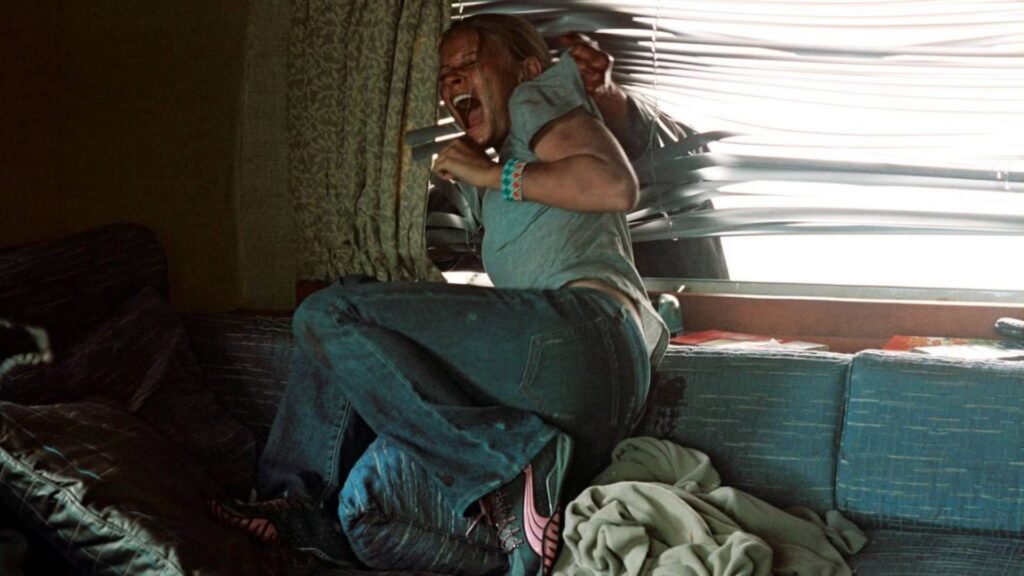
What Aja and Levasseur brought to the remake was more polish, without negatively impacting what the original had to offer. Craven was limited by the budgetary restraints of the ’70s (the film was made on a reported budget between $350,000-700,000), but as time and advances in technology made it possible for filmmakers to achieve even more with their visions, he saw what talented filmmakers could do with the tools he lacked at the time he made the original movie. Armed with a larger, but still reasonable, budget of $15 million, The Hills Have Eyes remake could expand on some ideas that Craven wasn’t able to originally.
One of the areas that is aided by the passage of time and more money is the remakes’ practical effects. Aja and Levasseur had a vision of what the mutants would look like, and the inspiration came directly from the nuclear effects of Chernobyl and Hiroshima. Six months were spent on designing the mutants with K.N.B. EFX Group Inc., which involved a mix of using computer-generated materials for the sculptures that would then lead to creating the prosthetics that would be fitted to the actors before the cameras began to roll.
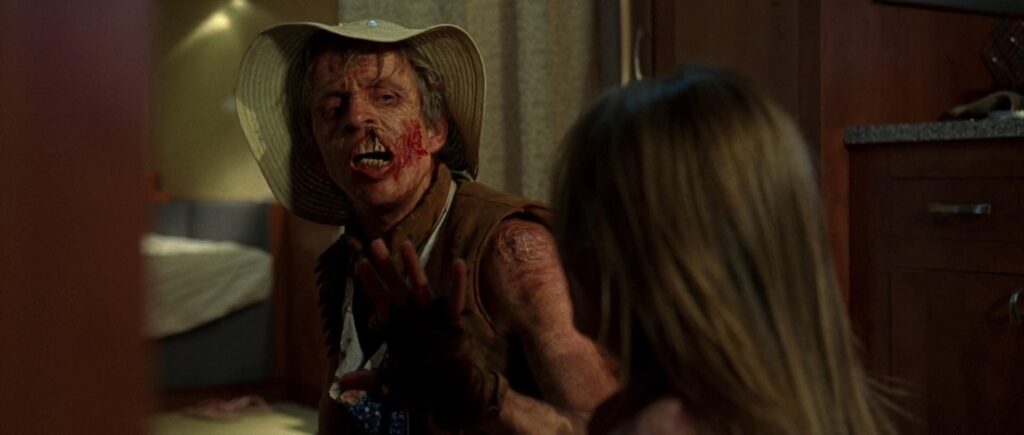
Actors such as Robert Joy, who portrays Lizard, spent more than three hours being transformed into mutants of mass destruction. Even renowned K.N.B. artist Gregory Nicotero got in on the fun with his cameo as the halo-headgear-wearing mutant named Cyst. In addition to what was done to create the grotesque physical look of the mutants, 130 visual effects were used to create the testing village that was originally one built street before digital magic took over the rest, adding touches to some of the mutants’ faces, which is most notable with the appearance of young Ruby (Laura Ortiz).
The look of the cannibals when compared to their appearance in the original isn’t a matter of one being better than the other. Even though the actual unusual physical appearance of someone like Michael Berryman, who portrayed Pluto in the original film, served to make him a character so iconic that he has been used across the film’s various promotional material over the years, there is still a realistic appearance to the look of the cannibals in that film that served the purpose of their origins. They’re a product of a messed-up personal backstory that led to an encounter with a depraved alcoholic prostitute, which only drove more dysfunction. They survive in the hills by cannibalizing travelers and stealing their supplies to maintain their own survival. It’s a bleak existence, but one that the creators behind the remake wanted to expand upon.
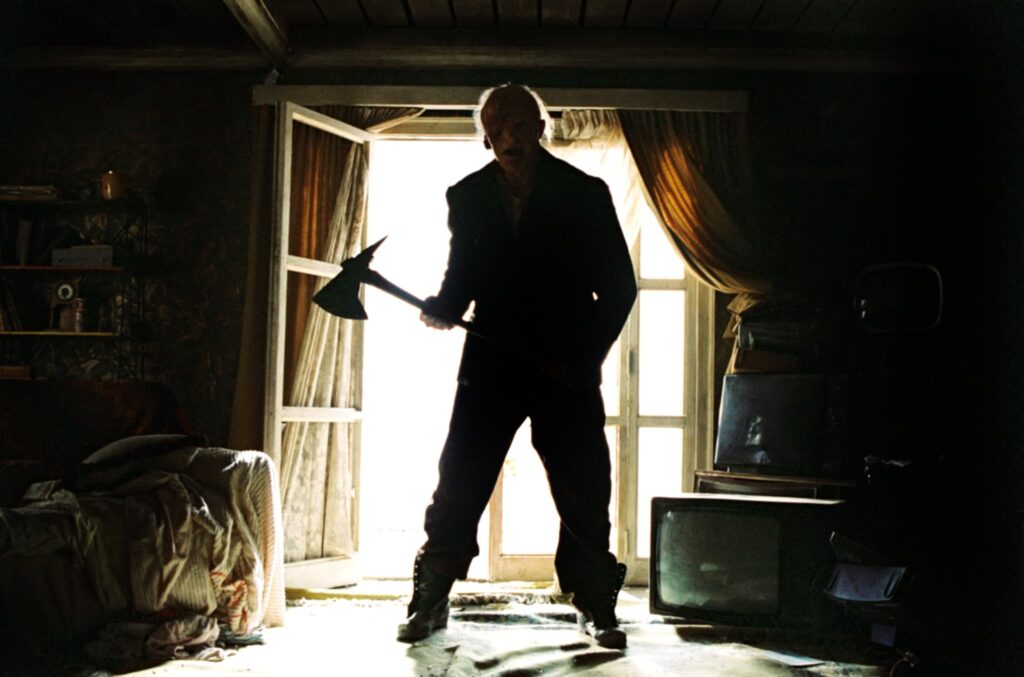
Due to the film’s more direct focus on nuclear testing leading to the deformities of its inhabitants, the cannibals had to look more like monsters stripped of their humanity. Some of them, such as Pluto (Michael Bailey Smith), Brian (Desmond Askew), and the aforementioned Cyst (Nicotero), make a strong impact because the monstrosity of their deformities is so profound. In the case of Lizard (Joy) or Papa Jupiter (Billy Drago), the deformities were apparent but not as physically alarming as some of their mutant counterparts. In the end, the film gets a proper combination of what made the cannibals register in Craven’s film, while also having the tools necessary to give some of them an appearance that matched the destruction of the events that created them.
The Hills Have Eyes remake also chooses not to skip on intensity, and it’s earned because of the slow-burn approach that allows the audience to get to know all the key players representing the family. It’s important that we get to know that Doug Bukowski (Aaron Stanford) is at odds with his father-in-law’s (Ted Levine) more Republican views and that he frequently takes shots at his manhood and unwillingness to bear arms.

The audience must see that Lynn (Vinessa Shaw) is devoted to Doug despite this and that the rest of the Carter family, including Ethel (Kathleeen Quinlan), Brenda (Emilie de Ravin), and Bobby (Dan Byrd), accept him as well despite their occasional playful shots at his personality. It all serves to ensure that the family is living, breathing people the audience can care about about also makes the violence thrust upon them have a purpose. Because of the events that take place later in the film, Doug has to embrace all the facets of his manhood that he appeared to lack, and the surviving members of the family by the end have to turn into the very monsters who attacked them in order to survive.
The cornerstone of the original film is the trailer attack on the family, and it’s still a standout sequence that registers due to its unflinching brutality. It would be a hard moment to top, but the remake does so because the film takes its time to get there before all hell breaks loose. The event happens in layers while ‘Big’ Bob Carter (Levine) is off at a nearby gas station to find help after their car breaks down (resulting in his capture) and then the mutants systematically using him as bait to infiltrate the trailer with Doug and Lynn’s young baby still inside along with Brenda, who is brutally attacked by Pluto and Lizard. By the time Lynn and Ethel make it back to the trailer, the brutality is set to reach a fever pitch that only makes the sequence even harder to watch.
Perhaps the most startling, yet effective, moment is when a gun is put to the head of Lynn’s young baby as Lizard begins to nurse himself on her breast milk. Shaw’s performance is blistering and alive here as she is clearly doing what is necessary to keep her baby safe. Despite what ultimately happens to her character by the end of the attack, she does get a moment to prove herself as a heroine who turns into the ultimate showcase of sacrifice.

The depravity in the remake makes the retribution, as the film heads to its climax, all the more rewarding. Doug, built up to be passive to his core, has to take charge when some of his family is slaughtered, and the only way to ensure survival is to fight back. Stanford’s performance is two-fold because he sells the man that the audience meets at the film’s start, and makes it effortless when he has to engage in blood-soaked vengeance that includes him taking his fair share of beatings from Pluto, which leads to him being locked in a meat locker full of limbs at one point. He goes through the paces, but he never gives up when it’s clear that getting to this point is a necessity.
The same is true of Brenda and Bobby. The former endures her own brutality at the hands of Lizard and Pluto, which makes it all the more satisfying when she gets her own agency in the end, following the pair setting a trap to turn the tables on their attackers. Bobby is a character who loses a bit of his innocence as the events unfold. He’s the first to realize something isn’t right after finding the body of one of their German Shepards, Beauty, clearly torn apart from a violent encounter.
He has to suffer yet again, following the trailer attack, when insult is added to injury when Papa Jupiter takes his mother’s body and begins to feed on it out in the open. The Hills Have Eyes remake takes the survival-at-all-costs nature of the original and simply makes it bigger by raising the stakes for all the characters. Hell, even Beast (the surviving German Shepard) still gets retribution for Beauty, but it’s a moment with much more bite that resonates for the audience.

Released on March 10, 2006, The Hills Have Eyes opened to $15.7 million during its debut weekend and went on to gross $41.7 million domestically and $70 million worldwide on a $15 million budget, making it a success. Reviews were mixed upon release from mainstream critics, registering a 51 percent on Rotten Tomatoes with a consensus that reads, “Faster paced for today’s audiences, this Hills remake ratchets up the gore for hardcore horror fans, but will turn casual audiences.” The criticisms came from some critics who unfairly labeled the movie as torture porn due it arriving in the wake of films such as Saw and Hostel. The movie was viewed more for its violence by some, with the late Roger Ebert giving it a negative review by saying the film was focused more on violence than its characters (sometimes it feels like critics are watching completely different movies) and that the film’s villains were “simply engines of destruction.” Leave it to Bloody Disgusting, one of the havens for all things horror, to pushback against the torture porn allegations by bluntly stating, “Some may call it ‘torture porn’-those people are idiots.” It might not be eloquent, but it served to make the point that the movie was much more than that.
The Hills Have Eyes remake is an example of how to do reboots right. The spirit of Craven’s original is always present, and it never bastardizes what came before. His family was used as a launching pad to expand and improve while paving its own path. Arriving during a time when horror remakes were in season, The Hills Have Eyes could’ve easily gotten lost in the shuffle, but it remains a highlight and continues to secure its place as one of the best horror remakes ever. Twenty years later, this is a remake that stands the test of time and shows everyone how it’s truly done.
For more on Horror, make sure to check back to That Hashtag Show.

![Michelle Yeoh Enters The Multiverse In ‘Everything Everywhere All At Once’ [Trailer]](https://www.thathashtagshow.com/wp-content/uploads/2021/12/everything-everywhere-all-at-once-michelle-yeoh-440x264.png)


 That Hashtag Show
