
Bryan Fuller started his career as a contributing writer to Star Trek Voyager and Star Trek Deep Space Nine. An avid fan of Trek, he submitted spec scripts and found his way into the industry. Since then he’s created and produced numerous hit series including Pushing Daisies and Hannibal.
With Dust Bunny he enters the world of feature films.
While technically it is his debut, he’s been crafting high quality as a showrunner for so long he is well equipped to bring a unique vision to the screen. He has, in his own words, ‘honed communication skills’ which brings him to this moment well prepared.
There are a number of things about the film that stand out, which is impressive on its own in an era of safe bets and familiar titles.
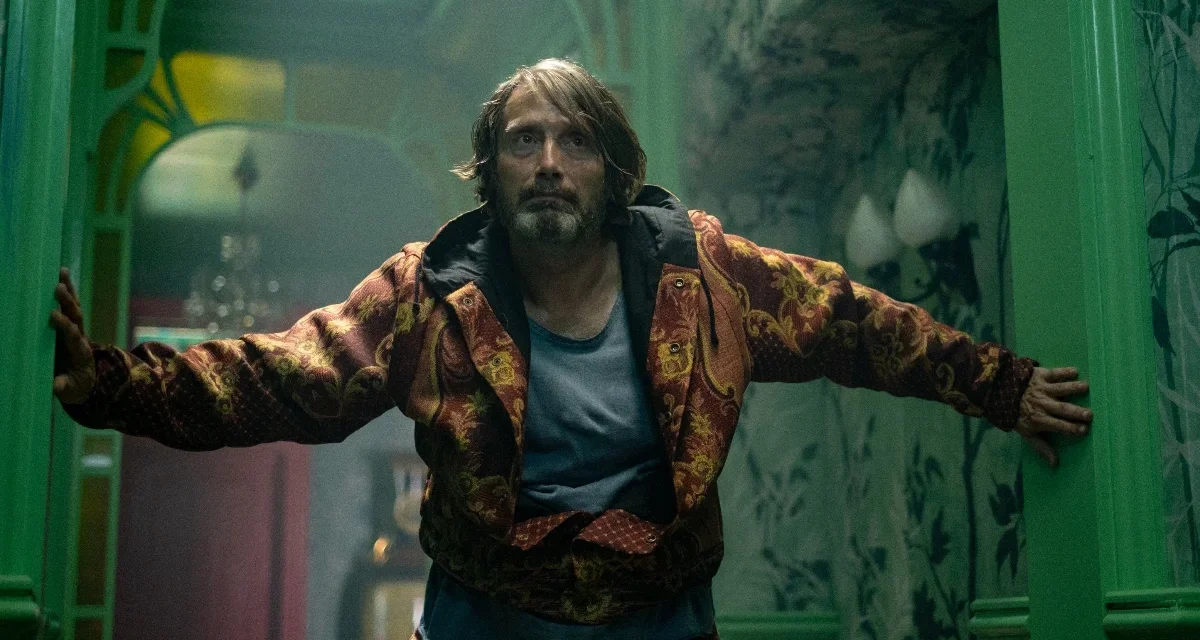
Dust Bunny features one of the most extreme examples of aspect ratio usage in movie history at 3:1. Yes, you read that right. One of the only earlier examples of someone going this wide was Able Gance for Napoleon (1927) a french silent epic whose final sequence was at an aspect ration of 4:1. Gance did it with something called ‘Polyvision’, which was three reels of silent film projected in a horizontal row. A very tricky piece of coordination.
Fuller uses the extreme width and low height to emphasize the ‘floor is lava’ nature of the circumstances for his lead character Aurora (Sophie Sloan), as well as to help create the feeling of looking for a monster under your bed. These visuals are central to the effectiveness of horror-thrills of the film.
A new Side of Mads Mikkelsen
Audiences will see a different side of star Mads Mikkelsen in Dust Bunny. Fuller knew the actor well enough from their time together on Hannibal to know there was more there to work with, aspects of his personality not yet mined on-screen. It’s always a treat to see a director/actor collaboration that comes with some inner knowledge of one another and helps bring a new type of performance to the forefront.
Mikkelsen keeps his patented mystery, but gets to show a softer side as well as heroic qualities that have been kept dormant in most appearances to date. The reception of Dust Bunny would suggest that we’re likely to see more films from Fuller in the future, and given his unique creative sensibilities, that’s a good thing for all of us.

![Netflix’s “The Unforgivable” Starts Off Strong, But Then Goes Off The Rails [REVIEW]](https://www.thathashtagshow.com/wp-content/uploads/2021/11/project_20211123_1028440-01-440x264.png)

 That Hashtag Show
