
![How Park Chan-wook and Lee Byung-hun Crafted The Complex Of The Masterful ‘No Other Choice’ [Interview]](https://www.thathashtagshow.com/wp-content/uploads/2025/12/4345ef52-972a-4c00-9aed-a1d3444704f0-1280x640.jpg)
Park Chan-wook’s masterful No Other Choice isn’t just one of the year’s best films: it’s one of the best of our era. Simultaneously funny and heartbreaking and punctuated with desperate violence, it’s a stunning indictment of contemporary capitalism as much as it is a complex showcase of the depths it can bring an otherwise outstanding citizen to. Known for his stunning vengeance trilogy (Sympathy for Mr. Vengeance, Oldboy, and Lady Vengeance) as well as Thirst and the noir Decision to Leave, Park Chan-wook is no stranger to violence in his filmography. No Other Choice stands out, however, in its abstraction: vengeance isn’t meted out from an aggrieved plaintiff against a personal slight. Here, a character’s fall from grace results from the indirect violence of the job market.
We follow Man-su (I Saw The Devil’s Lee Byung-hun), a company man at a paper company who gets laid off after 25 loyal years. Thrown onto the callous job market while trying to care for his wife Miri (Son Ye-jin), and two children, months turn to over a year as Man-su’s hope dwindles. After an embarrassing interview guts his last remaining hopes, he gets a devastatingly grim idea: why not take out his chief competition until he’s the top man on the job market? Man-su’s desperate, neither a sociopath nor a true killer, so we watch the desperate man stumble through a deadly, often ill-conceived plan, in a bleak but hilarious black comedy loaded with insight and nuance.
We had a chance to sit down with Director Park and Lee Byung-hun, who is coming off a wildly successful year, both in this excellent entry and as Gwi-ma, the king of the demons, in KPop Demon Hunters. In the interview, we discussed the moment that most stands out to Director Park, his secret for balancing the film’s incredibly complex tones, and star Lee Byung-hun’s penchant for playing characters on a downward moral spiral (but who you can’t help but empathize with).
The Impact and Importance of Man-su’s First Kill
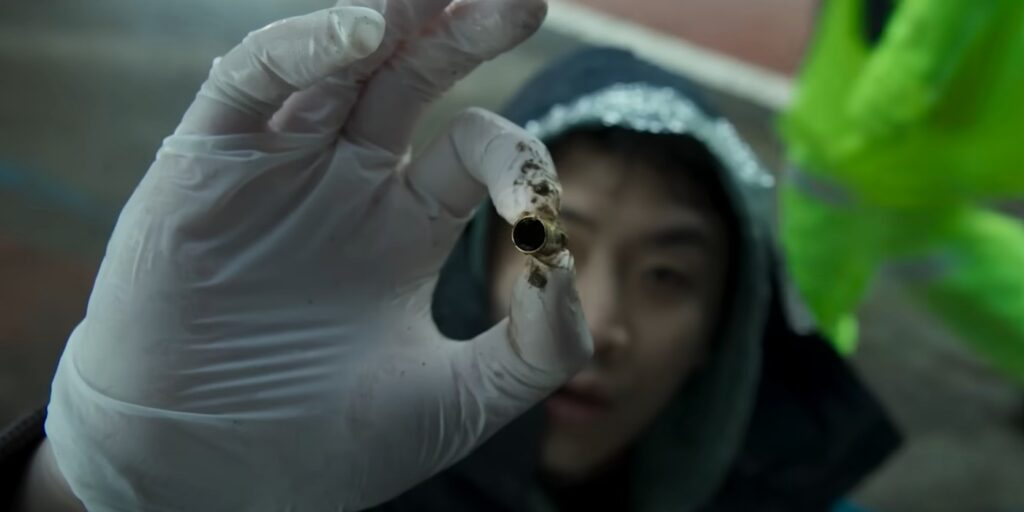
Director Park is well known for memorable scenes, like Oldboy‘s infamous hammer fight, the beach finale of Decision to Leave, or Lady Vengeance‘s terrible parental video viewings. Of the myriad great scenes in No Other Choice, he told us that “the Red Dragonfly scene” was his most memorable, referencing Han-su’s very first murder (set to an audiophile’s listen of Cho Yong Pil’s “Red Dragonfly” turned up sky high). “It’s a scene where we put in the most work,” he tells us, as well as ” It was “one of the first scenes that we storyboarded.”
The “Red Dragonfly” murder is also important to the film for both thematic and structural reasons, he explains. “In terms of the runtime, it’s also right in the middle of the film.” he notes, “So just when it starts to get a little boring and the audience is spacing out, the scene explodes and pull them back in… And it’s also a scene that portrays a character relationships and demonstrates the style and the personality of the film best.” As a consequence, Director Park explains that the sceen ” So it “really is a consolidation of the film, and the most representative scene as well.”
How Lee Byung-hun Brings Empathy To Characters In Moral Free Fall
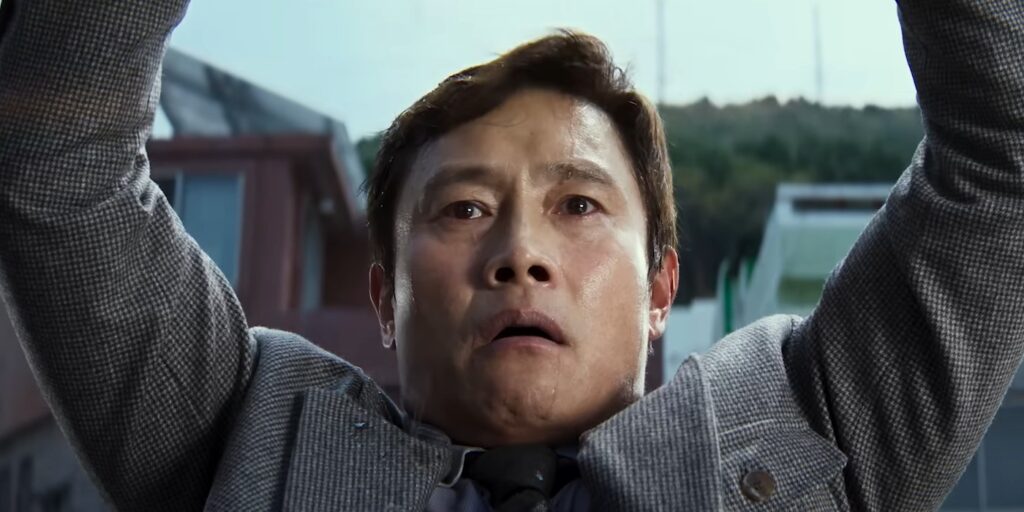
No Other Choice‘s portrayal of Man-su’s descent into desperation and moral compromise (to put it lightly) is an interesting one, given that the subtle comedic tone and empathetic portrayal allow audience empathy for the character, even while he’s doing terrible things. It’s a balance that star Lee Byung-hun has walked before, at least in I Saw The Devil, in which he played a detective on the hunt for the serial killer who murdered his wife. Vengeance makes him do terrible things in the process. “While I Saw The Devil and No Other Choice are very different movies,” he says, “I think you can make the connection that they both explore morality and a sense of humanity, and in these very extreme and drastic scenarios, the main character is a very ordinary person that is faced with these scenarios.”
In each film, the character is a desperate man engaged in a deadly venture that’s far outside his desires, though the path in I Saw The Devil goes to darker places (given that it stems from a far more personal grudge). “At the start of the story, you really see that they are going through a very drastic change,” he explains, “And it is my job as an actor to be able to convince the audience of this change that occurs within the character.” It’s a difficulty, expecially in light of the need to balance audience sympathy against a downward spiral, but Lee accepts the complexity, explaining “this can feel like a challenge, but also a challenge that I really want to attend.”
Director Park’s Secret For Effortlessly Sliding Between Humor and Intensity
The balance of these different elements is one that Director Park excels at, adeptly combining pathos, intensity, and humor throughout his oeuvre. While No Other Choice leans a little more on the comedic side, that’s no less true here. In balancing those often diverse tones, he tells us that he never thought of them as distinct. “If I consider it as moving from one spot to a different spot, I think the movie would’ve felt a lot messier,” he says, “But that was never how I approached it.” By contrast, Director Park explains that he “always considered everything as one entity, whether it be social commentary or an individual’s tragedy, and how man’s actions feel very comical to us.”
The source of his ability to balance these elements is finding them in each other. He continues:
“All of these elements have always been inseparable, a single entity for me. And I think that approach is important, and that I never considered them as combining different things. Because when you think about it, you feel sad as you laugh at these characters. Or you’ll be in a funny moment, but also feel very sad at the same time. The audience might laugh at Man-su, but also feel sorry for him. I’ve always wanted all of those things to feel like one thing… the story feeling both sad and funny, all of these things are fundamentally derived from the state of being this tragically unemployed man.”
No Other Choice hits select theaters in the U.S. on December 25.
For more on Movies, make sure to check back to That Hashtag Show.


 That Hashtag Show
