

This weekend marks the release of the science fiction thriller Mercy, directed by Timur Bekmambetov and starring Chris Pratt and Rebecca Ferguson. The film is set in 2029 Los Angeles, as a detective stands trial for the alleged murder of his wife, and he has just 90 minutes to prove his innocence to an AI judge, or he will be put to death.
The film offers a future in which law & order could be decided by something perceived as much more advanced than humans, a concept explored by other films in the past. Should Mercy not be your cup of tea this weekend (the reviews aren’t promising), or if you’re looking for something similar to get your futuristic fix, here are five police-dystopian movies guaranteed to hit the spot.
5. Demolition Man (1993)

If you’re looking for a police dystopian film that doesn’t take itself too seriously, but is still a blast, Demolition Man is the one. Directed by Marco Brambilla in his feature debut, the film is based on a screenplay by Daniel Waters, Robert Reneau, and Peter M. Lenkov. It opens in 1996, when police officer John Spartan (Sylvester Stallone) and crime lord Simon Phoenix (Wesley Snipes) are cryogenically frozen after Spartan’s failed attempt to rescue hostages from Phoenix. Fast forward to 2032, Phoenix has now escaped, and Spartan is awoken from his frozen sleep to help capture him.
Much of Demolition Man shouldn’t work on paper, but it largely succeeds because it’s sharply self-aware. The film also delivers a surprisingly prophetic vision of the future that still resonates today. The societal restrictions it depicts serve as a clear example of government overreach, something people continue to fear and, in many ways, still experience.
Stallone’s persona is perfect for the film because it takes the machismo he was known for at the time and juxtaposes it with a comparatively tame future, where physical touch, swearing, meat, and salt are all banned by 2032. Also, if living in a franchise world where all restaurants are Taco Bell isn’t enough, Snipes’ Simon Phoenix remains one of the best ’90s villains and is a true showcase for the actor’s screen presence and charisma. Throw in a pre-Speed Sandra Bullock for good measure, and Demolition Man remains one of the best of its kind, despite its early ’90s sensibilities.
4. Equilibrium (2002)
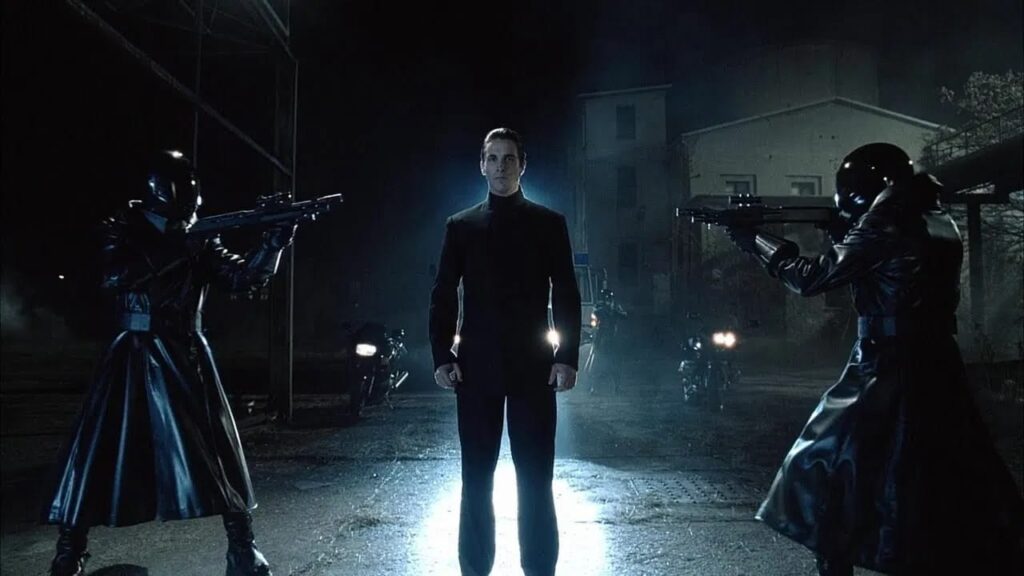
For a more somber, yet stylistic, look into the future, look no further than the underrated science fiction film, Equilibrium. Written and directed by Kurt Wimmer, Equilibrium follows John Preston (Christian Bale), an enforcement officer working in a future where feelings and artistic expression are punishable by law. To ensure that society doesn’t feel these things, the citizens are forced to take a psychoactive drug called Protium to keep their emotions at bay. It’s not until Preston himself accidentally misses a dose of his drugs that he begins to uncover the truth about the totalitarian state he has sworn to uphold.
While Equilibrium doesn’t skip on action (while creating its own unique fighting style in the process), it’s the film’s premise that makes it an intriguing effort from start to finish. The fact that the government is overreaching so far that they have chosen to suppress emotions because that is the true enemy, just indicates that higher levels of authority fear the true capabilities of the human mind. By declaring music, art, and literature as “Sense Crimes” that can lead to death due to these laws, it just shows that the government depicted in the film is afraid of the evolution of the mind and its ability to question things that simply don’t feel right.
Bale’s John Preston is a compelling protagonist. He’s an officer sworn to uphold the law, but once his mind is awakened to new possibilities, he must wrestle with his desire to evolve on a more human level. Equilibrium is also known for introducing Gun Kata, a fictional martial art that the director reportedly developed in his backyard. The style turns gunfights into something fluid and almost poetic, based on the statistical probability of where enemies stand and where bullets are most likely to land. Some argue the film “ripped off” The Matrix due to their similar aesthetics and shared use of gun-based martial arts. However, Equilibrium approaches its ideas in a far more cerebral way. Despite poor reviews at the time (a 40 percent score on Rotten Tomatoes) and a box office failure, the film has since become a true cult classic—and one well worth revisiting.
3. Blade Runner (1982)
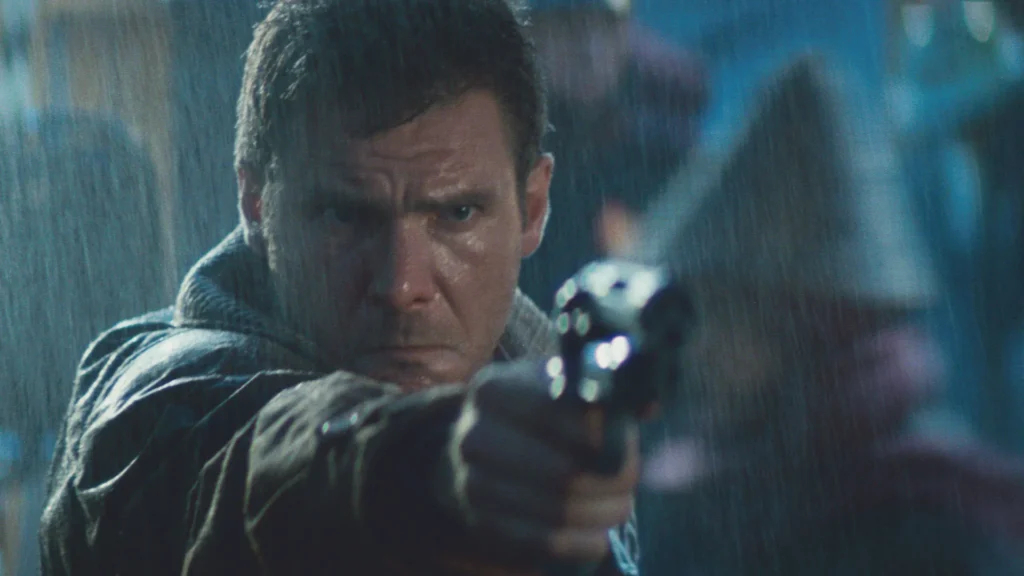
Blade Runner is often considered the granddaddy of dystopian sci-fi, thanks largely to Ridley Scott’s masterful direction and its timeless aesthetic. Written by Hampton Fancher and David Peoples, the film is adapted from Philip K. Dick’s 1968 novel Do Androids Dream of Electric Sheep? Set in a dystopian Los Angeles in 2019, the story follows a world where synthetic humans known as replicants are created by the Tyrell Corporation to work off-world. When a group of advanced replicants led by Roy Batty (Rutger Hauer) escapes to Earth, a reluctant former cop, Rick Deckard (Harrison Ford), is tasked with stopping them. Scott found beauty in a future that wasn’t clean or polished. Rather than a sleek vision, Blade Runner presents a darker, more lived-in world.
The film’s rain-soaked look is its signature, and even though it showcases a grimy version of a futuristic Los Angeles, it’s still a visually stunning piece that makes it hard to takes ones eyes off of it. It’s also widely believed that Blade Runner made Cyberpunk a known term and aesthetic with its mix of scientific advances and neon advertisements juxtaposed with the decay of society. Blade Runner is more than a science fiction action film and demands the viewer dig deeper into its themes. The concept of “what is human” is a big theme throughout the film as the replicants simply want more life, and even though they aren’t technically human, they show more human tendencies than the flesh-and-blood individuals hunting them.
This is truly showcased during a pivotal scene with Hauer as his big monologue, reportedly largely improvised, makes the audience question if he’s truly evil or if it’s men that are the true monsters of the film. Keep in mind, there are different cuts of this film ranging from the thearical, director’s and “The Final Cut” but whatever version you watch, Blade Runner is a film ahead of its time that may not have hit the way it should’ve in 1982, but certainly found its audience later as a cult classic and one of the greatest science fiction films of all time.
2. Minority Report (2002)
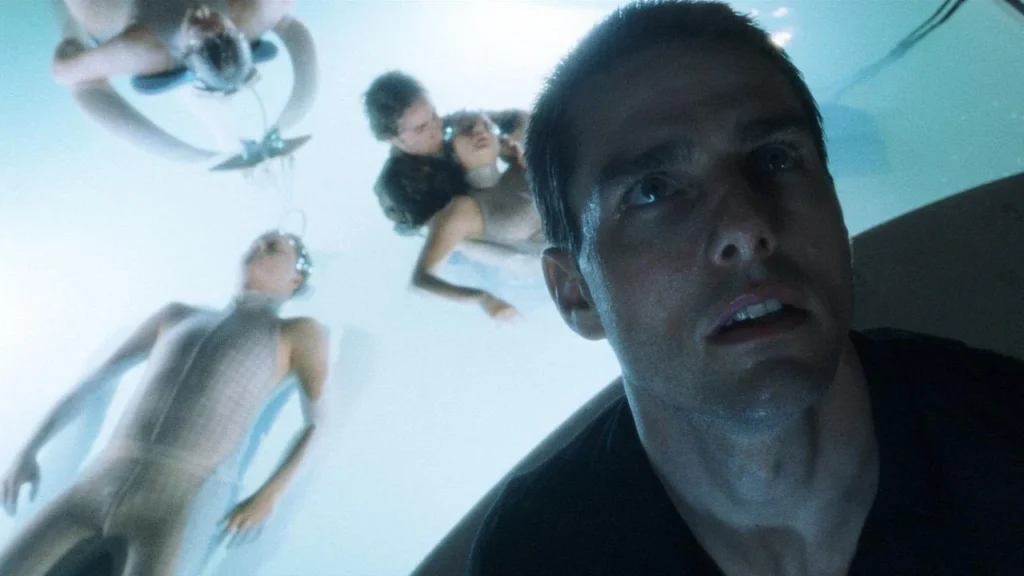
Many reviews of Mercy compare the film to Steven Spielberg’s Minority Report, and not always favorably, as Spielberg’s film is far more intellectual and a true classic of the genre. Written by Scott Frank and Jon Cohen, Minority Report is based on Philip K. Dick’s 1956 novella The Minority Report. The film is set in Washington, D.C., in 2054 and centers on a specialized police “pre-crime” unit. Their job is to apprehend criminals before offenses are committed, using the foresight of three psychics known as “precogs.”
Minority Report works because Spielberg can make the movie a true action blockbuster with popcorn movie tendencies that also challenge the mind. The government overreach here is surveillance, and the question of how much privacy a society should have to prevent unthinkable crimes from taking place. On the other hand, even given the perceived knowledge of the precogs, would it be right in any society to be arrested for a crime you haven’t committed yet? What if there are flaws in these procedures? Should individuals be punished for events that haven’t come to pass?
Minority Report explores the individual losing a sense of agency because a higher governmental element has already deemed them a threat. It leads to a society that could be free of murder, but there is a chance that it can become corrupted and used to target anyone perceived to be an enemy. On top of all of this, Minority Report is visually stunning and doesn’t look dated at all, despite being released in 2002. Admirably led by Tom Cruise at the top of his game, Minority Report ends up being a substantial think piece that doesn’t skip on thrills.
1. RoboCop (1987)
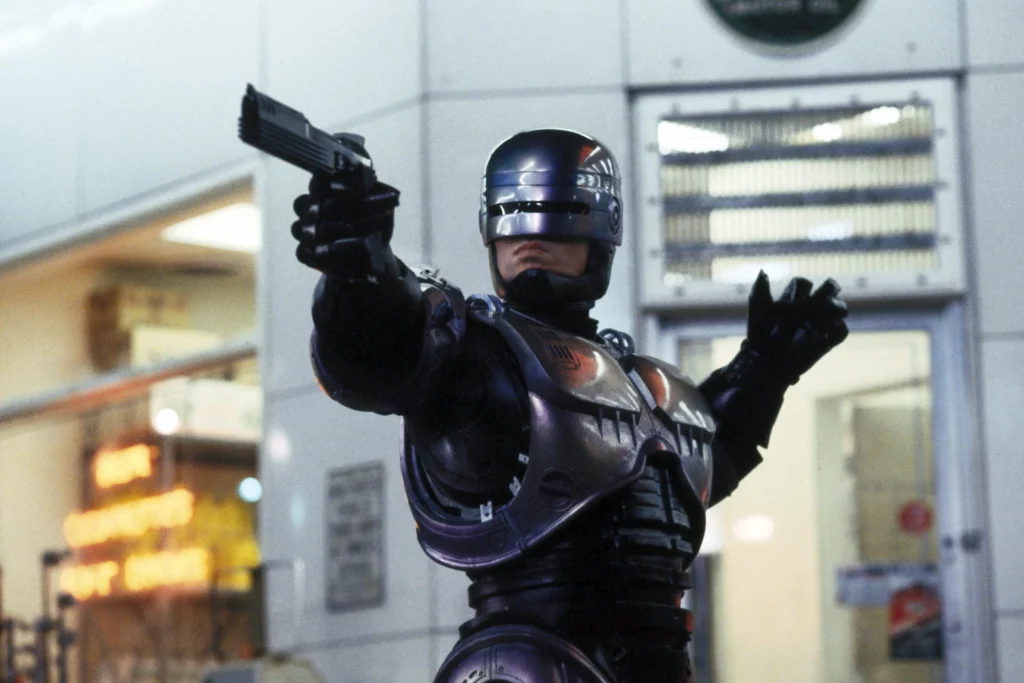
oboCop has always been intriguing because it could have easily been just an ultra-violent, machismo product of the ’80s. Instead, it has far more intelligence and heart than a run-of-the-mill action flick. Directed by Paul Verhoeven from a screenplay by Edward Neumeier and Michael Miner, the film is set in a crime-ridden future Detroit. The story follows police officer Alex Murphy (Peter Weller), who is murdered on duty by a gang of criminals. Following his death, he is revived by Omni Consumer Products as a law enforcement cyborg known as RoboCop. Although his memories are wiped, he slowly becomes aware of his former humanity while carrying out his brutal campaign of justice.
Look, it all sounds silly on paper, but RoboCop is far more intelligent than it has any right to be. Maybe much of this was done on purpose. Luring the audience in who wanted a dumb action movie, who were instead given a movie that still doesn’t skip on the action, but also has something of substance to say. Thanks to Verhoeven, who reportedly pushed for this, RoboCop is a savvy satire of media culture in the ’80s, with the director cleverly using the media breaks in the film to mock the consumption of violence and commercialism by the very people watching the film.
The film also demonstrates that while the thugs and criminals are certainly vile (Kurtwood Smith’s Clarence Boddicker is a villainous delight), the real threat is corporate greed and the men at the top in suits who are using public services for profit. Yes, RoboCop was created to serve and protect, but the true motivation of his creation was to drive more money to Omni Consumer Products.
Beyond all of this, though, is the film’s heart as RoboCop discovers the man he used to be and goes on a journey to remember who that man was. It’s all done through an ’80s action movie aesthetic that doesn’t shy away from violence, but at its heart, RoboCop is a movie about identity and self-discovery. Can a machine regain the thing that once made him human? RoboCop answers that question while being one of the best science fiction action films ever made that still holds up incredibly today.



![Prime Video: Outer Range – Don’t Let The Slow Start Fool You [Non-Spoiler Review]](https://www.thathashtagshow.com/wp-content/uploads/2022/04/outer-ranger-review-440x264.jpg)

 That Hashtag Show
