
When Steven Knight’s excellent gangland tale Peaky Blinders wrapped its sixth series, it was a mighty satisfying end to the story of Tommy Shelby. A sober Arthur Shelby (Paul Anderson) avenged Aunt Polly (Helen McCrory) by killing Captain Swing, but he skipped out of a farewell meal with brother Tommy Shelby (Cillian Murphy). The latter discovers that Tommy discovered that his inoperable tumor was a fascist ruse courtesy of Oswald Mosley (Sam Claflin), and set his caravan aflame. A free man with his past burning behind him, Tommy left the Peaky Blinders behind just as his son Duke joined the gang.
Peaky Blinders: The Immortal Man follows a wild new era for all involved. Tommy has been in self-imposed exile since leaving the Peaky Blinders behind, intending to write a book in isolation. His son, Duke (now older and played by Barry Keoghan), has taken over leadership of the gang. Nihilistic from a life of abandonment by Tommy, Duke has a terrible, destructive reputation. He makes a deal with the scheming Nazi Beckett (Tim Roth) to facilitate a dangerous Nazi plot that could destabilize the United Kingdom. Kaulo (Revecca Ferguson), the twin sister of Duke’s mother and a powerful Gypsy seer, arrives at Tommy’s compound to convince him she can give Tommy peace if he turns Duke around, he re-enters the life for one final outing.
The Immortal Man Excels Thanks To A Top-Notch Cast

One of the things that Peaky Blinders has always had going for it is style. This really applies across the board: precisely dressed characters engage in high-stakes action, beautifully shot and thoughtfully edited as perfectly chosen needle drops play in the background. It’s almost as if the local underworld operates under the law that the coolest gang has the largest turf, and the Peaky Blinders are always the coolest gang. That’s no different in The Immortal Man, which is just as bathed in immaculate style and technical precision as the series it concludes. It certainly feels like a proper continuation of the beloved series, and while the pacing is a little slow at times, it’s punctuated by moments of well-coordinated action that work well.
Cillian Murphy continues to evolve Tommy Shelby, still plagued by demons and looking for peace. Despite being out of the criminal life, Tommy wastes no time establishing himself as the criminal king once committed to the return, and Murphy’s command of the character’s presence is electric and layered throughout. Barry Keoghan shines as well as the violent, daddy-issues-ridden Duke, whose bravado and unpredictability are engaging to watch, and prove far more than one note in practice. Rebecca Ferguson oozes mystery and confidence as Kaulo, oozing a version of the serpentine power she pulled off so well in Dune, here utilized to upend Tommy’s life. She brings an interesting light to Tommy’s brooding whenever the two are onscreen, though the light’s a little more ‘nuclear fallout’ than it is a hearth-warming fire. Finally, Tim Rock brings a smart, scheming vibe to Tommy’s new Nazi foe, who never feels outmatched, whether he is or not. For the final hurrah of a beloved series (at least until the sequel iteration emerges), they picked a powerhouse cast to see it home.
The Series Provides A Fitting End To The Tale of Tommy Shelby
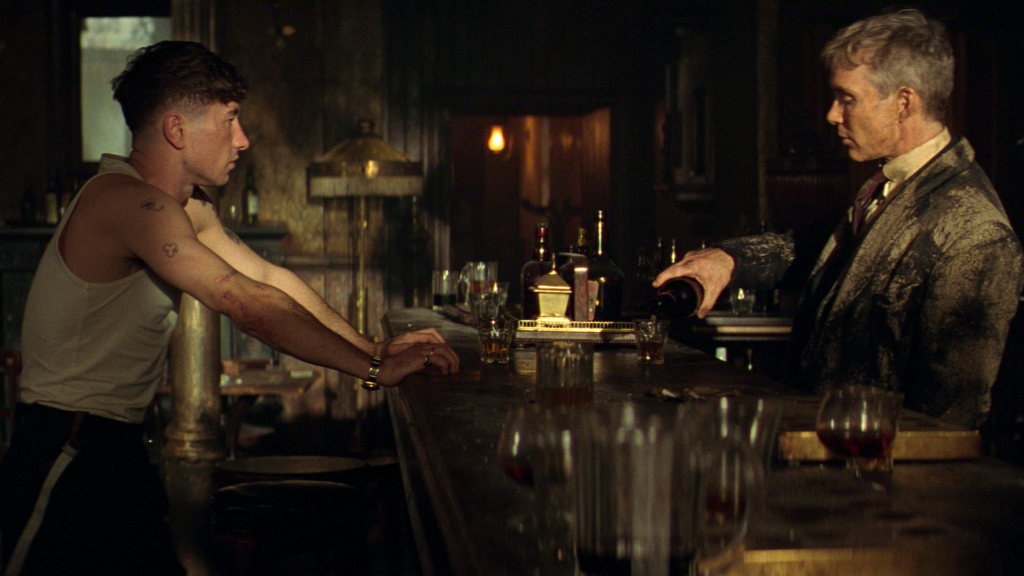
The Immortal Man has a lot going for it, between events of monumental importance, a fantastic cast, and style to spare, but there are a few gaps in the narrative that impede its overall success. That’s not entirely a surprise, given the inherently diminished amount of screen time a film has relative to a series, but it’s nonetheless notable. Tim Roth’s baddie gets memorable screentime, for example, but it feels like there’s a missed opportunity to make him even more of a threat as a whole. The emergent Nazi threat isn’t necessarily dispatched quickly, but once the conflict starts, it feels a little too quick, in part perhaps because there are so many other elements to wrap up. Additionally, the film’s catch-up with Arthur’s life before the film starts deserves greater development, while the arc between Tommy and Duke is well-scripted, immaculately performed, and feels earned, but there’s reason to lament that we don’t get the elevated interactions between Barry and Cillian that we might if the film were a whole series. All that said, it’s a fitting conclusion to this Peaky Blinders series.
It’s a little hard to believe that Peaky Blinders debuted a whole 13 years ago, its first series already standing out as one of TV’s great gang dramas. Cillian Murphy always excelled as the traumatized-but-capable-planner Tommy, who was regularly fighting on the back foot but never at a true disadvantage. Steven Knight’s style–slick production, heavy modern music, and wild plot turns–set it apart as an all-timer, providing a legacy that’s a lot to live up to. The Immortal Man manages to stick the landing and provide some finality for Tommy and co., and though it isn’t always fully satisfactory, it rings true and captures the energy a proper sendoff would require. As a whole, it’s a great finale to one of TV’s finest series.
Peaky Blinders: The Immortal Man hits select cinemas on March 6th, before heading to Netflix on March 20, 2026.
For more Reviews, make sure to check back to That Hashtag Show.




 That Hashtag Show
