
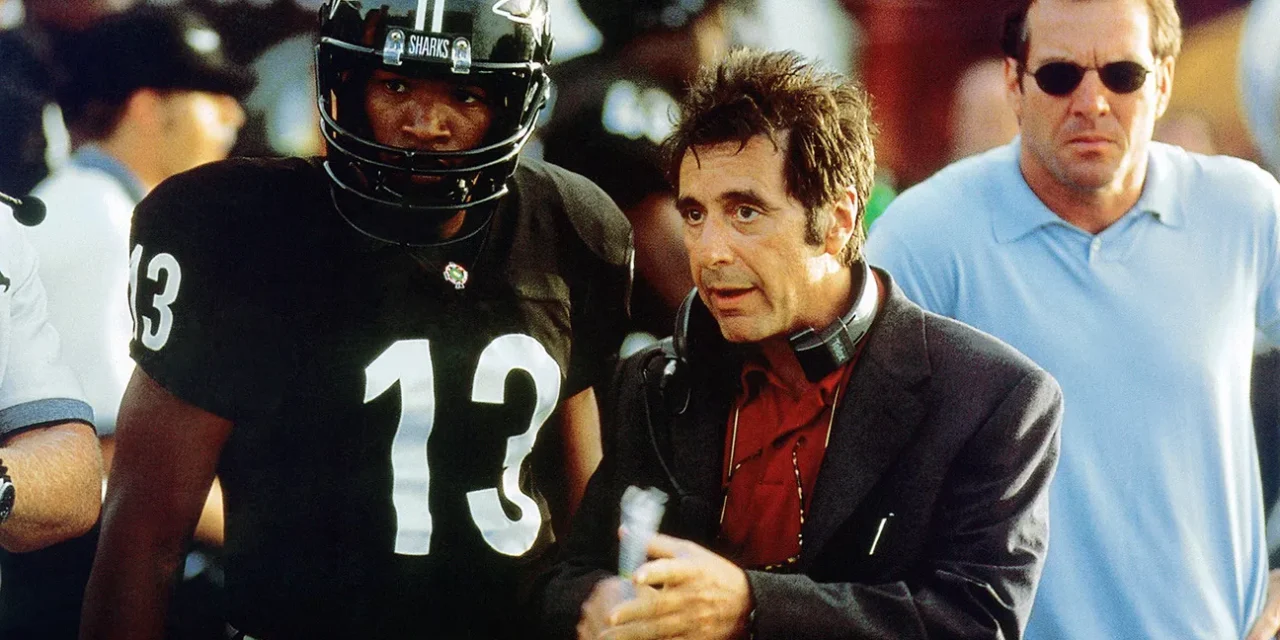
This week is Super Bowl Sunday, and as football fans prepare for the New England Patriots and The Seatle Seahawks to go head-to-head, proper movie prep might come in handy to get you hyped for the big game. Thankfully, we have you covered with five football films that are more than capable of getting you in the zone for the big game.
Honorable Mention: The Replacements (2000)
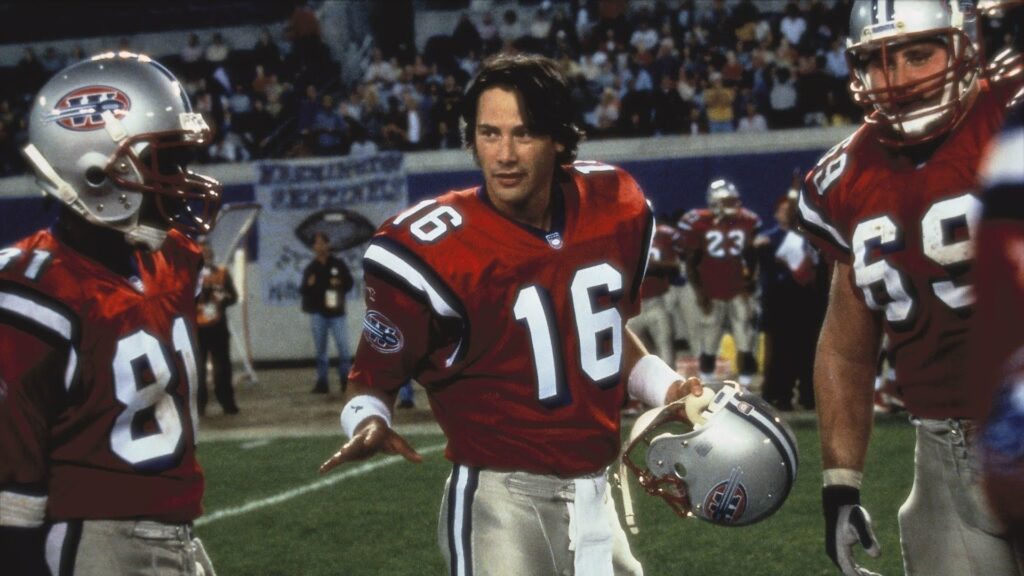
If you’re looking for a fun underdog story, The Replacements fills that void effortlessly. Directed by Howard Deutch from a screenplay by Vince McKewin, The Replacements is loosely based on the 1987 NFL strike and the Washington Redskins, who went on to win all three of their replacement games without any of their regular players and carried those wins to become the champions of Super Bowl XXII. The film depicts the Washington Sentinels with the team’s owner, Edward O’Neil (Jack Warden), turning to his former coach, Jimmy McGinty (Gene Hackman), to coach the Sentinels for the rest of the season with replacement players.
Should they win three of their last four games, the Sentinels will get into the playoffs. The Replacements is pretty much like comfort food and works because of its lighthearted charms and its ensemble cast that also includes Keanu Reeves, Orlando Jones, Brooke Langton, Rhys Ifans, and Jon Favreau. The reason a lot of football films succeed is because of their underdog stories, and The Replacements utilizes that to offer up 118 minutes of solid entertainment that make it a suitable movie for Super Bowl Sunday prep.
5. Varsity Blues (1999)
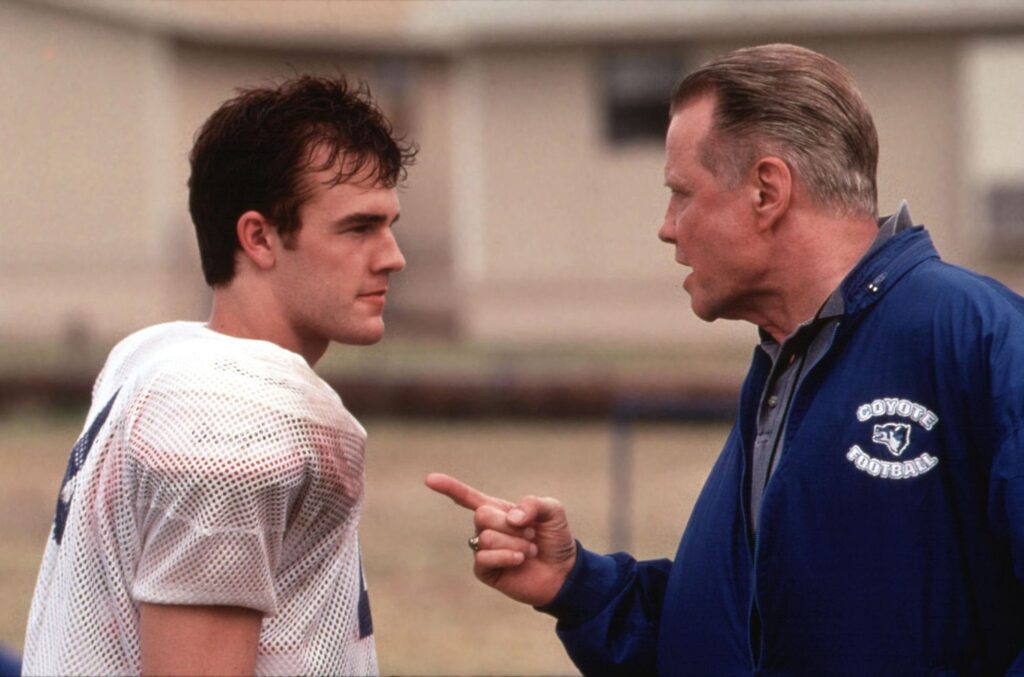
Should you want a bit of teen movie nostalgia to mix with football entertainment, Varisty Blues provides that, but with much more depth than you might expect from an MTV Productions release led by the star of Dawson’s Creek. Directed by Brian Robbins from a screenplay by W. Peter Iliff, Varisty Blues depicts a small-town high school football team in West Canaan, Texas, dealing with the pressures of their football-obsessed community and a head coach (Jon Voight), who rules with an iron fist. Varsity Blues may function more as a coming-of-age movie rather than a definitive football film, but it does an admirable job of diving into the toxicity of high school football and how sometimes parents live vicariously through their kids.
The movie doesn’t fully glorify the sport and showcases the pressure players can go through, even as they are getting started in high school. That’s not to say that the movie doesn’t have the heart of the sport in its DNA. By the end, the cliched game that brings it all together for good measure is on full display, and its outcome does its job to illicit cheers. James Van Der Beek, known more for portraying Dawson Leery on Dawson’s Creek at the time, leads the young cast without showing shades of the idealistic movie fan he was playing on TV. It’s a performance that allows him to show range, and he’s given sufficient support from Paul Walker, Scott Caan, and Ron Lester as his fellow teammates.
However, it’s Voight’s Coach Bud Kilmer who steals the show here. He has a scary intensity in the role that elevates the material and likely brought the best out of the younger cast. Of the teen movies released during this period, Varsity Blues aspired to be more than a film showcasing pretty faces. It really wanted to shine a light on how the obsessive nature over football can put an ugly stain on the sport.
4. Rudy (1993)

Should The Replacements’ more lighthearted, comedic underdog story not do it for you, Rudy’s tug-at-the-heartstrings tale of emotional perseverance might be just the football movie for you. Directed by David Anspaugh from a screenplay by Angelo Pizzo, Rudy is a biographical sports drama that depicts the life of Daniel “Rudy” Ruettiger (Sean Astin), who, despite the obstacles stacked against him, dreamed of playing football at the University of Notre Dame. Rudy gets a lot of mileage from its true-life inspiration, making it hard not to succumb to its emotional themes.
As a viewer, it’s easy to relate to Rudy because sometimes there are barriers that get in the way of your dreams, and for the titular character, it’s his small stature and mediocre grades. In the face of all of this, it’s easy to root for him because Astin’s performance is passionate as he brings you into all of the emotional weight that he’s going through. Rudy is all about having true grit and heart for the sport and going for it, even though on the surface, it appears you may lack what it takes to succeed. While the film does take some Hollywood liberties with the true story, its heart is in the right place.
Besides, who doesn’t want to stand up and cheer when Rudy Ruettiger plays in the final game and successfully sacks the Georgia Tech quarterback? From being validated by his team and the crowd chanting his name, and the respect he earns by being carried off the field by his teammates, Rudy might engage in cinematic manipulation, but there’s no denying how well it really works.
3. Remember the Titans (2000)
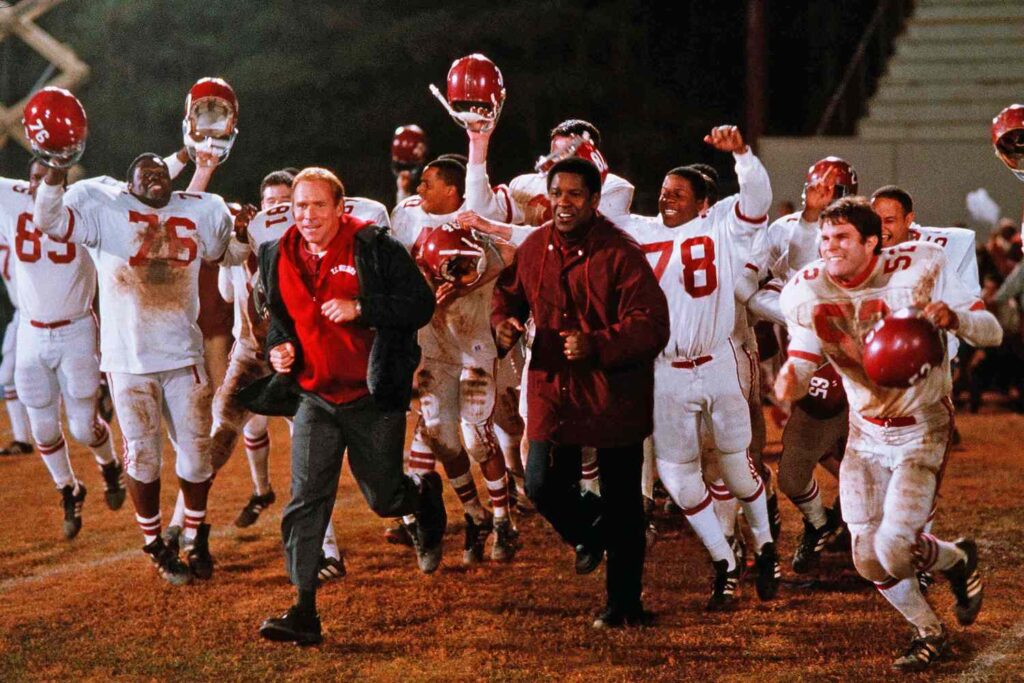
Sometimes a football movie can be about more than the sport, and Remember the Titans is a great example of this. Beyond its depiction of the sport, Remember the Titans is also a story about social change and overcoming the nastiness of racism, where football is used to bring people together, even though society at the time promoted more division rather than unity. Directed by Boaz Yakin from a screenplay by Gregory Allen Howard, Remember the Titans is a biographical drama that is loosely based on coach Herman Boone (Denzel Washington). Herman desired to integrate the T.C. Williams High School football team in Alexandria, Virginia, in 1971 despite the bigotry he faced in doing so.
Even though Remember the Titans is a Walt Disney Pictures production, it doesn’t shy away from shining a light on the issues going on at the time. It tackles the subject of racism with respect and doesn’t diminish the struggles that came along with it, but it does successfully use the integration story about the T.C. Williams High School football team to show how something like football can do its part to bridge those social divides. It’s a story about character and community, featuring characters with emotional depth that help navigate its inspirational story.
Sports and football are all about camaraderie and brotherhood, something that is given some standout moments here as the black and white players on the team get to know each other and learn to bond, despite their differences. Leading the charge here is Washington as Boone, whose natural presence as a leader gives the production gravitas. Remember the Titans will always earn my personal respect because it could’ve easily been a sugarcoated look back at this moment in time, but it’s an honest portrayal that uses football as a setting to tackle some serious themes that ultimately lead to unity in the face of division.
2. Friday Night Lights (2004)
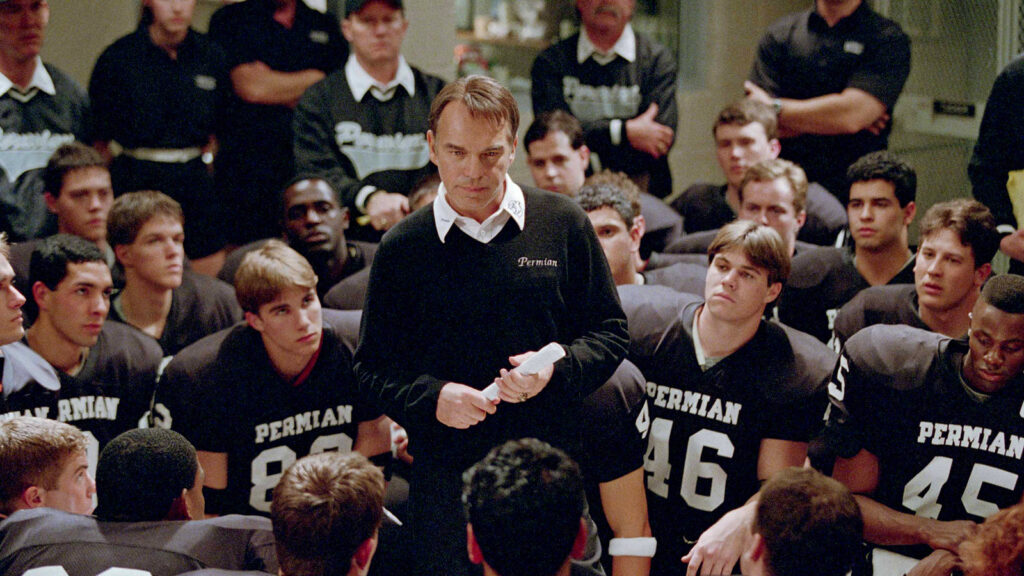
Friday Night Lights combines the emotional depth of its story with a you-are-there documentary-style that adds grittiness to the proceedings. Directed by Peter Berg from a screenplay he co-wrote with David Aaron Cohen, Friday Night Lights is based on the book Friday Night Lights: A Town, a Team, and a Dream by H.G. Bissinger. The book followed the story of the 1988 Permian High School Panther football team and their journey towards the state championship, and the film captures the intensity of the time as Coach Gary Gaines (Billy Bob Thornton) tries to guide his Texas team to success.
First and foremost, it’s Berg’s direction that brings much of Friday Night Lights to life with his use of handheld cameras that pulls the viewer into the intensity of the sport. He gives the film an authentic atmosphere and even utilizes this handheld technique during some of the more subdued emotional scenes, which draws the audience into the emotional weight of its characters. The typical pratfalls of the sport are depicted here, with the intense pressure to win mixed with the obsession that a small town can put on its young players that leads to other personal struggles.
The latter aspect is another reason Friday Night Lights stands out. The film takes time to go beyond the sport to look into the personal lives of the players to show how their real struggles make them more than just players on the football field. Even though there is a real grittiness to Friday Night Lights, there is a real vulnerability to its story that makes it resonate. It also doesn’t succumb to a typical Hollywood ending, which might upset some who want ultimate triumph, but Friday Night Lights ends on a more poignant note where winning isn’t necessarily everything.
1. Any Given Sunday (1999)
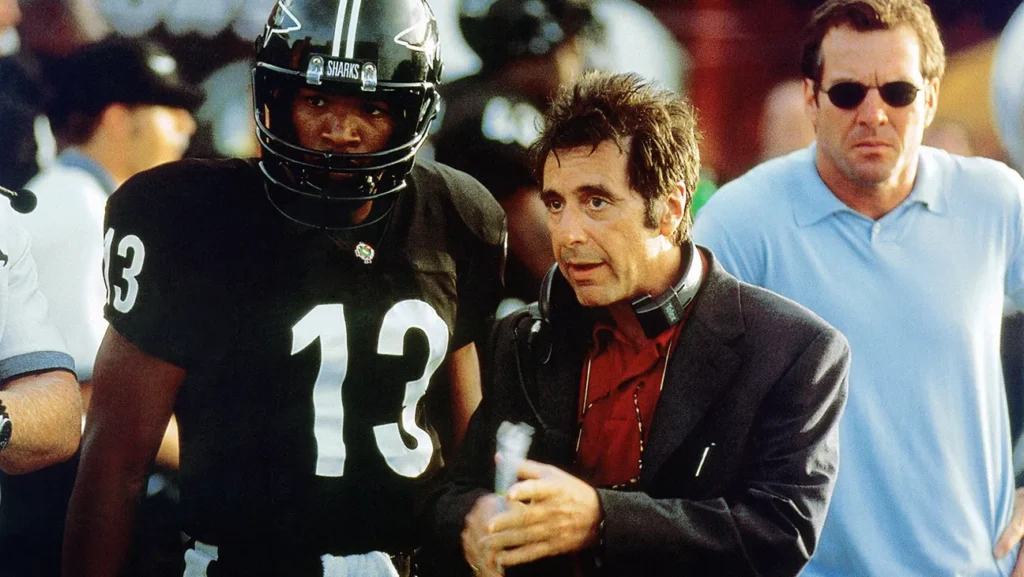
Much like Friday Night Lights, Any Given Sunday is a gritty and visceral depiction of professional football and the sometimes less-than-savory behind-the-scenes practices that determine what plays out on the field. Directed by Oliver Stone from a screenplay he co-wrote with John Logan, Any Given Sunday is loosely based on the 1984 novel On Any Given Sunday by Pat Toomay and portrays a fictional football team by the name of the Miami Sharks who, while once at the top of their game, are struggling to make it into the 2001 AFFA playoffs.
Coached by Tony D’Amato (Al Pacino), a thirty-year vet, he finds his job being dictated by Christina Pagniacci (Cameron Diaz) and falling out of favor with his offensive coordinator, Nick Crozier (Aaron Eckhart), as they move away from Tony’s more traditional coaching techniques to win at all costs. Stone captures the kinetic energy of game play through a visceral editing style that makes the audience feel every hit going down on the field. Even though football is a fun pastime and is watched by millions, it’s sometimes forgotten that there is violence inherent in the sport, and Stone doesn’t shy away from it. His directing style makes football feel like a way is going off on the field, and it’s a technique he uses in some of the scenes that don’t play out during the game.
Diaz more than holds her own during several shouting matches with Pacino, proving that at the time she had much more dramatic weight than her more light-hearted comedic efforts indicated. Also providing top-notch work is Jamie Foxx as Willie Beaman, a third-string quarterback who finds himself at the heart of the game following starting quarterback Jack “Cap” Rooney (Dennis Quaid) being injured. At the time, Foxx was known for comedy, and even though some of that energy is on display (the “My Name is Willie” song remains a highlight), it’s the intensity he brings to his dramatic scenes as a black player who has felt he has been slighted for his race that truly resonates.
Also of interest is how Any Given Sunday looks into the business and politics of professional sports, which can be ugly, and also the personal lives of the players, particularly how injuries can make some of them literally feel like they’re losing their lives. While Any Given Sunday can come off as chaotic and extreme at times, it never loses track of its complex themes and unflinching look into the good and sometimes very bad of professional football.
Happy Super Bowl Sunday everyone!
For more on Movies, make sure to check back to That Hashtag Show.



![Huesera: A Battle Between The Existential & The Supernatural [Review]](https://www.thathashtagshow.com/wp-content/uploads/2023/01/project_20230103_1149315-01-440x264.png)

 That Hashtag Show
