
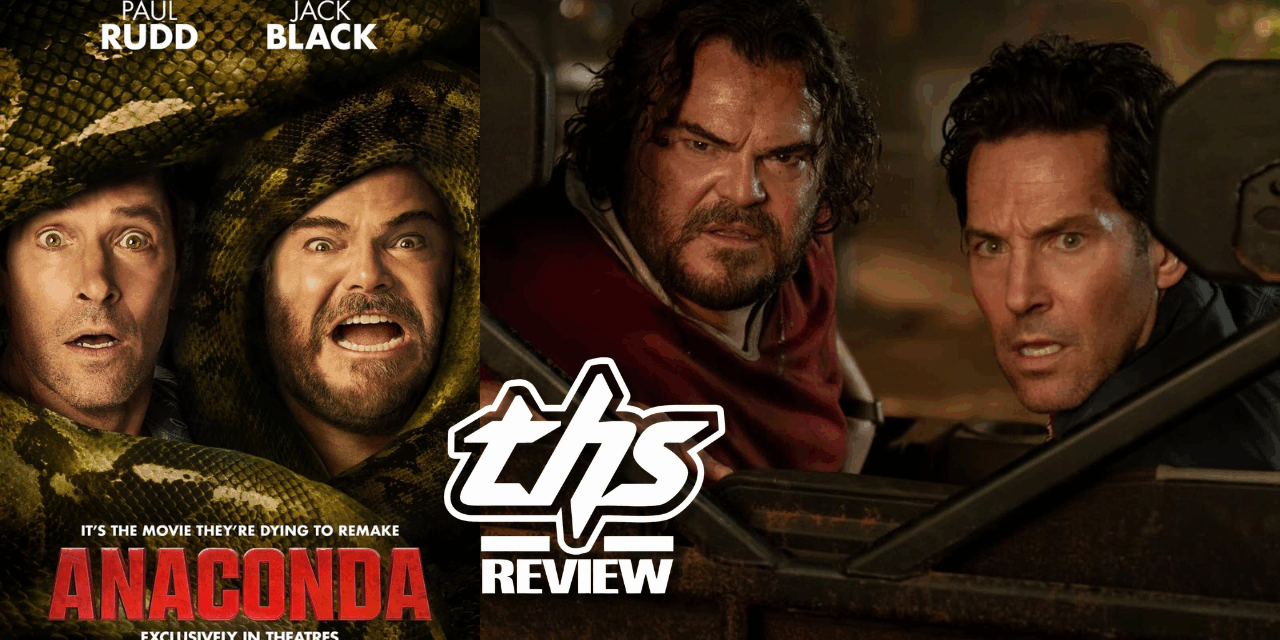
In the era of reboots, franchises, sequels, prequels, and requels, Anaconda (2025) provides a somewhat refreshing take on the endless parade of revived intellectual property. Its self-aware humor stems from the simple premise that a few nimrods, led by Jack Black and Paul Rudd, whose Hollywood dreams fell through, have a shot at rebooting the Anaconda franchise themselves on a shoestring budget. Antics ensue when their fiction becomes a reality, and the shoot is disrupted by a real massive Anaconda trying to kill them.
It’s not an entirely original premise on any level, with Tropic Thunder being one of the more recent and successful iterations on the concept, but movies as far back as The Three Amigos and Ernst Lubitsch’s To Be or Not to Be both also built plots around dumb Hollywood types being thrust into the real conflict.
The movie does poke fun at itself and its industry, with some crowd-pleasing cameos and very meta dialogue. The core ‘theme’ of the film, something the characters within the film recognize as critical to success, addresses how the lead character Doug (Jack Black) gave up on his dreams to pursue what is called out as a “B/B+” life. The subtext, intentional or not, is fascinating. More on that later.
The Cast of Anaconda Shines
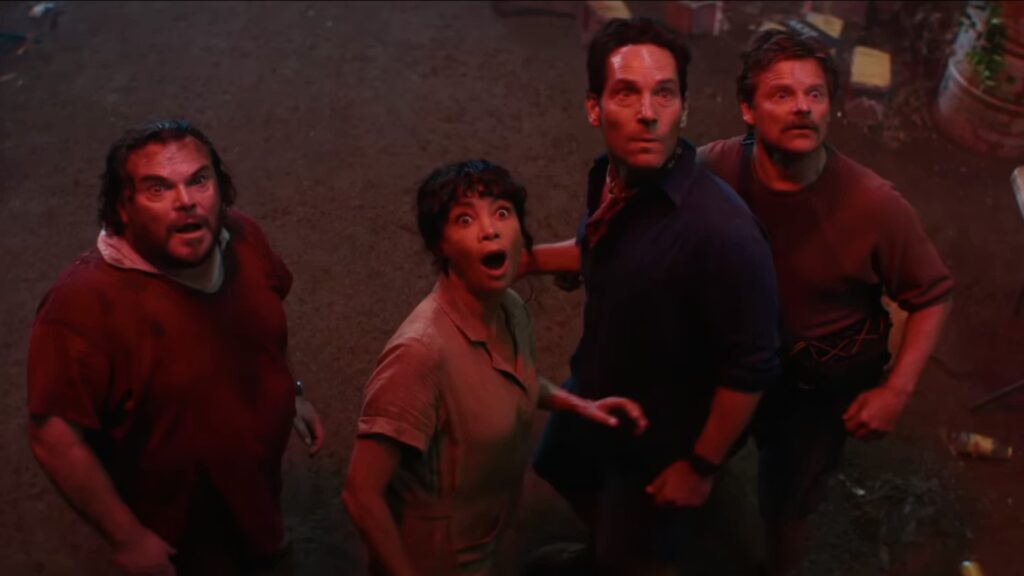
Jack Black and Paul Rudd actually play a bit against type this time out, and for the most part it works really well. Rudd is frequently more of a straight man in his long (seemingly ageless) career, but his ability to get goofier has always been lying in wait. Black, known for his larger-than-life presence on every platform he touches, is in a role reminiscent to his work in Peter Jackson’s King Kong all those years ago.
Black isn’t just playing another filmmaker here, he’s playing a character with an arc, with inner demons, with something to prove, and he bites into a few dramatic moments embedded in this zany chaos.
The two leads bring so much to the table in every scene, whether it works or not, because they have elite comedic sensibilities and timing. Unfortunately, Rudd’s character is tasked with a number of sequences that go on too long, or don’t feel rooted in much beyond him having to be silly, which veers into cringe territory.
Comedy so often in the last few decades, has depended entirely on quips and asides, which is hardly comedy at all. Commenting on what is happening on screen or delivering a line in a strange way isn’t actual crafted comedy. A joke, and a comedic scene, need to be structured around certain elements. Groundwork laid, a situation developed, and then some ironic tension that explodes into humor.
There is a reason comedy is the hardest thing to pull off. In the era of the quick laugh and the fear of failure, it’s been far too easy to do comedy lazily. Anaconda has plenty of this, but it does also deliver a number of genuinely funny sequences. You’ll just have to take a bunch of ‘leaps’ of logic to go along with it.

There are sequences that build to absurd heights, but if you stop and think about them, or bump against any of the stretches that get you there, it may not play off as that funny. Newton’s character doesn’t have much going on for the most part, but she does the best she can, providing something of a counterbalance to the guy’s goofiness and the absurdity of the proceedings. Zahn plays the guy with issues, psychological as well as substance-related. He gets into a bottle of pills that gets him super high at precisely the wrong time, and he’s full of half-baked commentary and ideas. The archetype is pretty familiar, but if you haven’t tired of seeing this character a million times already, you’ll surely enjoy Zahn’s take because he does it quite well.
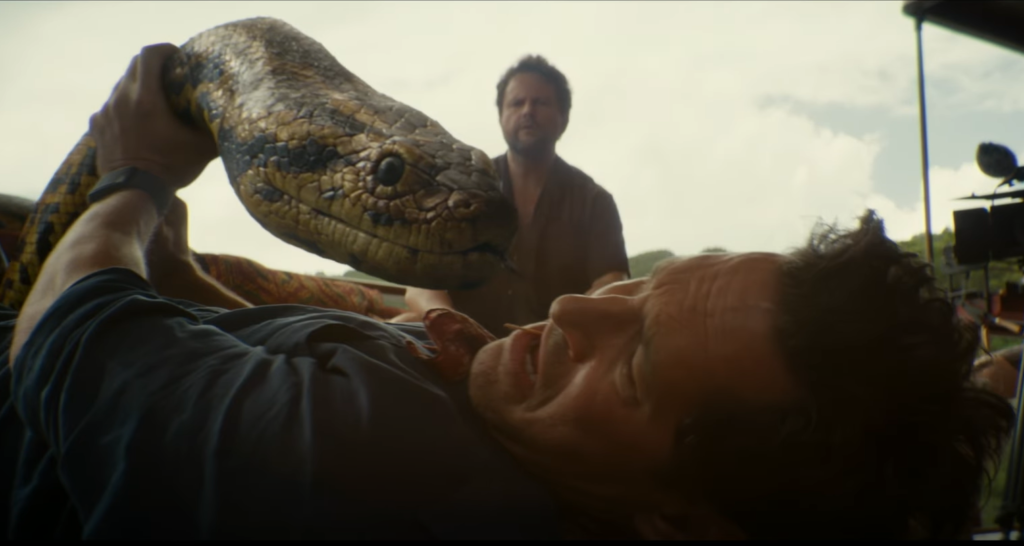
Selton Mello plays snake handler Santiago, a bit of a successor to Jon Voight’s character in the 1997 version. Mello’s accent and delivery are the joke most of the time, but his supposed deep love for his trained camera-ready Anaconda is deflated by plot-tailored moments that don’t quite align with who he is supposed to be.
There is also Daniela Mechior as Ana, a character with a high-stakes mission for jungle gold who gets wrapped up in the gang’s adventure. She’s doggedly pursued by gun-toting mercenary types who seem to die over and over again with unending and unseen reinforcements. Her B-plot is there to help beef things up, but never really works at all.
The issue in Anaconda is mainly the writing, because for every good comedic situation, there are a bunch of convenient writing choices that had to ignore established character traits or force circumstances to arise. It may be forgivable for many audiences since it’s “just a comedy” but it is undeniable that some of the pieces just don’t come together quite right. A perfect example is in one of the funnier sections, a mad dash across an open field becomes necessary, though it’s hard to understand why the snake, who has attacked from every angle at any time in any area, is more of a threat in the field than anywhere else. There are also long sections of wandering ‘lost’ that end with the characters finding exactly where they need to be at exactly the right time. These things hold an at times good movie back from being great.
Unrealized Dreams and Unintended Subtext
Anaconda (2025) comes at a very interesting time, considering some of its implied subtext. As 2025 draws to a close, the movie industry is in a very precarious moment historically speaking, with a purchase of Warner Bros by Netflix threatening to change… well… everything.
The movie is about a few guys who didn’t follow through on Hollywood dreams, now trying to make good in the only way possible: a twist on existing intellectual property. The aforementioned timing though brings to mind the haunting question: is it becoming too late for anyone’s old school Hollywood dreams?
The emotional center of the movie is an old VHS tape stuck in a TV that Griff found in his parents’ attic. The tape is a movie Doug, Griff, Kenny, and Claire made in high school about some kind of monster hunting the kids, titled “The Quatch.” The Anaconda (2025) filmmakers do a great job capturing that common shared experience of kids with dreams, making no-budget movies with friends. The Quatch, though, serves as a reminder that most people didn’t used to dream of reboots and sequels. And while the gang seemed to love the 1997 film we don’t get the sense that they’ve spent the last 20+ years thinking about rebooting it. Or wishing it was being rebooted. Like so many filmmakers, film fans, and general audiences, they’re taking what they can get.
Which makes Anaconda(2025) its own strange commentary on itself, because it’s possible Doug McCallister is only escaping the B/B+ life of wedding videos for the B/B+ life of reboots. Is it maybe Hollywood itself that gave up on its dreams?
Anaconda releases in theaters on Christmas Day.
For more Reviews, make sure to check back to That Hashtag Show.

![Possession Goes Viral In A24’s ‘Talk To Me’ [Trailer]](https://www.thathashtagshow.com/wp-content/uploads/2023/06/talk-to-me-trailer-440x264.jpg)
![[Review] F9: The Fast Saga, Suspension Of Disbelief Can’t Save This Star From Collapsing](https://www.thathashtagshow.com/wp-content/uploads/2021/06/196750354_3020134738269328_8106940949618586174_n-440x264.png)
![Russell Crowe Is Back To Battle More Demons In ‘The Exorcism’ [Trailer]](https://www.thathashtagshow.com/wp-content/uploads/2024/04/Russ-440x264.jpg)
 That Hashtag Show
