
![‘Dracula’ – Luc Besson Sinks His Teeth into Familiar Flesh [Review]](https://www.thathashtagshow.com/wp-content/uploads/2026/02/bfbb0b62-5668-4246-96a0-0c30c3f22efc-1280x640.jpg)
Luc Besson’s career has twisted and turned down many paths since he burst onto the scene in the 1990s with his distinct visual style, and, on some level, it is surprising that he would now undertake yet another Dracula adaptation, seemingly out of the blue. There have been so many adaptations of the story; re-imaginings of the character, with even the famously unlicensed adaptation “Nosferatu” getting a remake just last year. Why again? Why now?
According to Besson, working with Caleb Landry Jones on “Dogman” convinced him he had found one of the great actors of a generation, and he couldn’t wait to figure out what project to put him in next. When going down the list of great roles, Dracula, apparently, was top of mind. In rereading the text, he discovered the angle he’d take with his star: the love story.
While love has certainly always been an aspect of the character, this version of the character and story truly hinges on the overwhelming power of Vlad/Dracula’s love for his princess and how that loss drives him.
The film opens with a sequence where the young prince and princess are in love, romping around, having sex, eating, and living happily without a care in their castle. Suddenly, Prince Vlad is dragged away to a battle he must fight. He has some inkling somehow that this endangers his beloved, and so he asks a religious figure to insist that God protect her in exchange for his actions in the coming holy war. Of course, God doesn’t listen, and she dies, driving Vlad mad with rage. He kills the Cardinal and denounces his faith, leading to his cursed immortality.
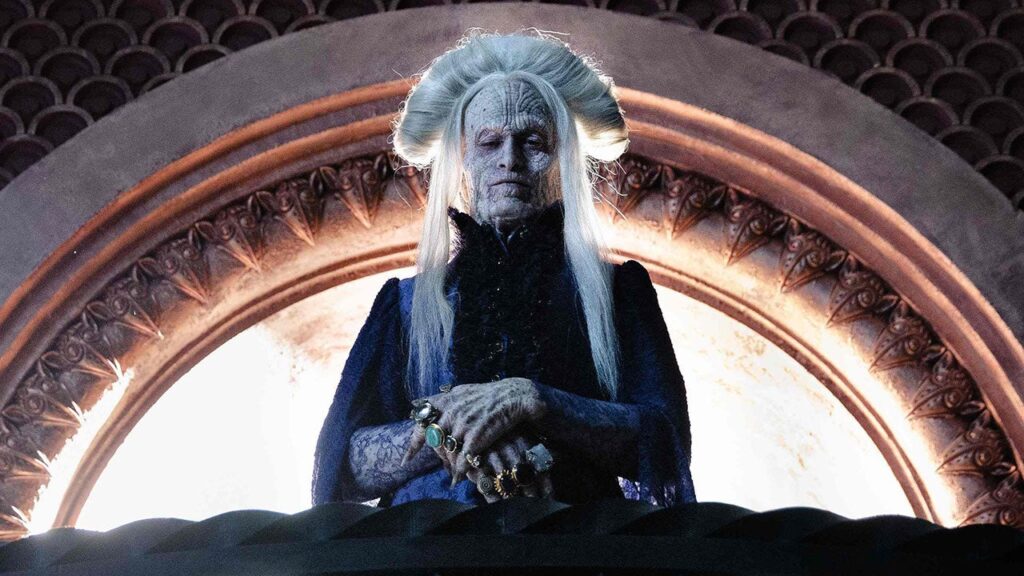
This backstory unfolds hastily, and the next thing we know, we’re 400 years later as an unnamed Priest (Christoph Waltz) investigates a Vampire found on the streets of Paris.
Soon, we catch up with Vlad, now a full-blown Dracula character with all the makeup, as he teleports around, creepily recounting his painful search for his beloved, believing she could be reincarnated. The bottom line is that while Besson’s version offers a love-tinted lens through which we can see the story, none of these themes are entirely new or original to the telling of the tale. At the same time, the plot remains largely familiar, likely leaving audiences to think more about how and why certain things vary from the other versions, or if they vary at all.
It may be that, despite Besson’s and Landry Jones’ best intentions, we have just seen this one too many times before. The fact that last year’s “Nosferatu” is fresh, albeit so different on the surface, surely doesn’t help matters. There are surely things to appreciate about Besson’s take, from his visual style to his effort to turn Dracula into something less monstrous and more human, relatable and tragic.; challenged and at times self-aware and funny.
Are we at a certain saturation point, though, with these types of legends? In the era of intellectual property that wins over studios and investors on some instant level, one wonders how long audiences will be able to keep signing up.

Assuming audiences are less familiar with the story and its adaptations, “Dracula” will provide an interesting experience of the character and mythology. The film asks the questions about what motivates him, what the cost of love is, and what kind of nightmare immortality could actually be.
On the other hand, something about the love affair in this one feels forced from the jump. Vlad and his princess (Zoe Bleu) are sucking each other’s faces off as soon as we meet them, declaring their undying passionate love for one another and dreading being separated, even for a moment. One has to wonder why. There isn’t much of an indication of what kind of chemistry the two have together; we are just told this is the most intense, undying love possible, and the rest of the story hinges upon that fact.
There is also a sequence where Dracula travels the globe, carefully crafting an all-powerful perfume to get women to find him irresistible, so he can draw them to him. This is another sort of leap of logic, not just in the concept of the perfume, but in the montage getting us there, doing so much of the work. There is a bit too much telling and not enough showing in these major plot points in “Dracula,” because audiences are more likely to accept leaps of faith when they feel more grounded in honest character behavior.
The Performance “Dracula” Was Built On
Caleb Landry Jones is, indeed, a deeply compelling performer. There is something in his hesitant nature, his line delivery, and his expressions that make him unexpected and unique. Buried under the makeup is a humanity and a humor that give him a unique charisma. To what degree is it by design? This is hard to know. It’s clear that Besson doesn’t care, and nor should anyone, since the end result is eminently watchable.
In an industry that often prioritizes vanilla for safety, down the middle archetypes and safe, familiar performances are built on wide appeal. A director and star who are going for the out-of-the-box is always a welcome change. Landry Jones would be dynamic in most roles; that’s just a fact, not just ones where he plays a strange, cursed monster. There is almost no doubt we’ll see the two pair up again, and we should relish it as much as they do.
The visuals are dynamic enough to hold the eye from one scene to the next, across eras and set pieces. Besson’s eye hasn’t lost a step, with plenty of colorful sequences, art direction, and costumes to pump some new blood into the seemingly undead plot.
“Dracula” is in Theaters February 6, 2026.
For more Reviews, make sure to check back to That Hashtag Show.


![Ticket To Paradise – Roberts And Clooney Can’t Save This [REVIEW]](https://www.thathashtagshow.com/wp-content/uploads/2022/10/project_20221020_1109233-01-440x264.png)
![‘Eddington’ Joaquin Phoenix And Pedro Pascal Are Locked In A Small Town Stand Off [Trailer]](https://www.thathashtagshow.com/wp-content/uploads/2025/06/Eddington-Pedro-Pascal-Joaquin-Phoennix-440x264.png)
 That Hashtag Show
