

Marty Supreme is exactly what the movies need. A24 anted up big time on Josh Safdie’s large-scale period follow-up to the electric Uncut Gems, and the result is a reward for audience and industry alike.
The excellence of the film is in every corner. There is gorgeous photography from legendary Darius Khondji, who burns bright period colors and cinematic shadow onto actual celluloid. There is a unique auditory world blending classic score, period 50s jukebox tunes, and anachronistically perfect 80s-era synth pop. This production design and costume work never misses, completely ensconcing us in a global experience of the 1950s from Egypt’s Pyramids to London’s Ritz to New York’s tenements.
Perhaps most impressive is the parade of unique faces, which provides the film with an ever-changing visual landscape and characters who come alive the moment we see them.

Marty Supreme doesn’t miss anywhere, but on top of all great work is the tip of the spear, a career-defining performance by already massively famous star Timothee Chalamet, and in his first solo effort as director, the announcement that Josh Safdie is this next generation’s great auteur.
The movie’s methods and success echo the era of 1970s cinema when auteurs paired up with unique leading men to deliver genre-defining and industry-elevating projects. Safdie’s approach to casting feels like Robert Altman’s approach to sound design, or George Lucas’ approach to visual effects. He and his team are pushing us to new places where we’re seeing better results.
The Venn diagram of co-writer/producer/editor Ronald Bronstein, Safdie, and Chalamet’s sensibilities and humor feels like what we got once upon a time with the likes of Jack Nicholson, Roman Polanski, and Robert Towne. Or Martin Scorsese, Paul Schrader, and Rober DeNiro.
This trifecta is in the zone, and they know it.
What makes this movie great goes beyond the sum of its parts, and should serve as a signal to the entire industry as the kind of direction required to win back the cultural relevance of the format and, in turn, save the struggling business model.
The foundation of all the film’s greatness lies in an inspired script from Safdie and Bronstein that explodes outward from the real-life story of Marty Reisman, a charismatic figure in the 1950s ping-pong scene. While there are similarities between Marty Mauser and Marty Reisman, this is most certainly not Reisman’s actual story.
Safdie’s personal connection through an uncle to the world of underground New York ping-pong got him churning about this world of hustling outsiders; a book about Reisman, given to Safdie by his wife, set the path more clearly. For Bronstein, the sports connection wasn’t enough. He drove deeper into the notion that Marty Mauser was a character gifted at something nobody took seriously.
The Next Great Movie Star
Much has been written about the last movie stars, or the fading power of an international star, with the likes of Tom Cruise, Brad Pitt, or George Clooney taking center stage as the business model, and the role of superstars changes in front of us.
Timothee Chalamet, however, is here to stay, and he’s shining as brightly as anyone.

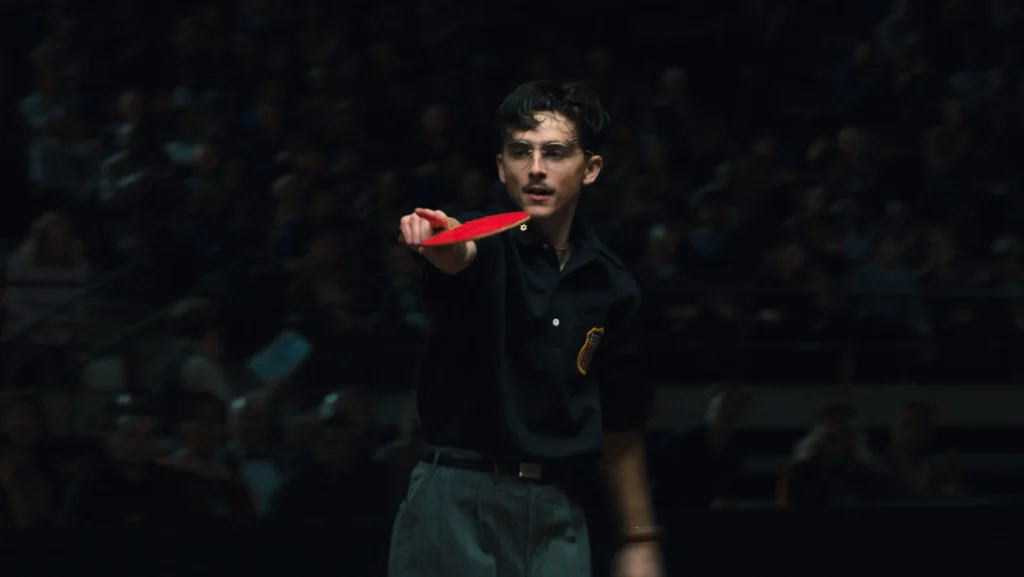
Chalamet’s Marty Mauser is a wizard with words and even more impressive with the paddle. From the moment the film starts, every scene is supercharged by Chalamet’s energetic take on Marty. He’s literally bouncing in the frame, a ping-pong ball all his own.
But beyond all the flourishes and dramatic chaos, this is a movie about growing up, becoming a man, and navigating those most insane big-dream periods of our youth.
When we meet him, Marty’s life is being set up for him by a constricting New York Jewish family in Manhattan. The smallness of it is closing around him like the boxes of shoes in his uncle’s store, where he’s working to buy a ticket to the ping–pong championship in London.
Chalamet never misses a beat, combining the audacity of the character with the humbling elements of his circumstances. He is at the same time larger than life and completely relatable. This is what makes a truly great icon of cinema.
Marty dreams big, and like so many young men, he doesn’t doubt his dreams at all. To him, these aren’t dreams; they are realities lying in wait. Safdie himself eloquently referred to dreams as an attempt to “hold fate hostage.”
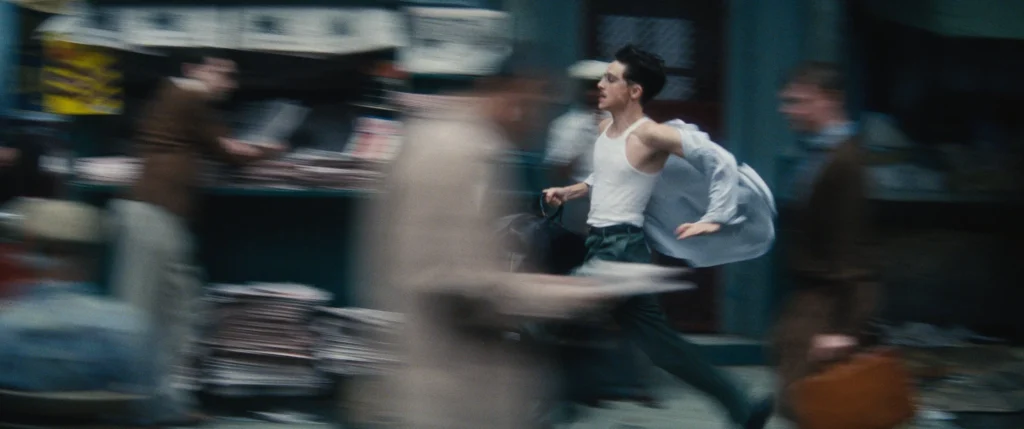
Marty won’t accept a fate planned for him. In short order, he’s in London, running up tabs at the Ritz, dominating the early rounds of the tournament, brazenly announcing his greatness to the press, and finding a way to get a super wealthy former movie star, Kay Stone (Gweneth Paltrow), to sleep with him.
Marty burns all the bridges with his fast-talking streetwise nature, a stew of obnoxious and absolutely irresistible in the deft hands of Chalamet.
Chalamet’s ability to make someone who’d probably be intolerable so likable and heroic is the kind of superpower stars should chase instead of the one with capes and tights. We’re at a unique point in Chalamet’s career. He has conquered the large-scale franchise with “Dune,” and this will be the second year in a row that his Christmas release is a critical darling, demonstrating his dominance.
He’s on one hell of a run, and his pursuit of greatness before our eyes makes the Marty Mauser role even more perfectly timed.
The second act kicks into high octane gear when Marty’s immovable self-confidence starts to be met with realities that refuse to conform. What follows is a masterfully tightly wound series of incidents and escapades that never take their foot off the gas.
Casting Genius Across the Board

While Marty’s goal is always unwaveringly locked on ping-pong supremacy, there is a subplot about his lifelong on-and-off fling with a neighborhood girl, Rachel (Odessa A’zion). Rachel is caught in a horrible marriage, with eyes only for Marty, and her unplanned pregnancy, which she’s sure is his (he’s sure it’s not), is the gasoline dousing the fire of Marty’s urgent antics.
There are countless incredible performances by recognizable names and faces throughout the film. Safdie and Chalamet’s love for basketball is woven deeply into the film with the legendary George ‘The Ice Man’ Gervin playing a key role, and beloved hooper Tracy McGrady popping up as a Harlem Globetrotter. The man with the golden voice, Ted Williams, appears, as does iconic filmmaker Abel Ferrara, who plays a plot-critical and dangerous gangster. Penn Gillette, Sandra Bernhard, Fran Drescher, and Tyler the Creator all populate this world, bringing completely realized and recognizable characters to roles without significant screentime but with impressive impact.
There is a genius kind of world-building Safdie does with the aid of casting director Jennifer Venditti. The special sauce is combining non-actors with pros to create scenes and moments that stand out from typical fare. You never see people who look this interesting on camera this much, and in some cases, they bring something to the performance of their own that no professional actor can approximate. The old adage that ‘90% of directing actors is casting’ is taken to a new level by Safdie, Venditti, and Bronstein, where they also use the tapes from non-actors to help them understand and find their characters.
The scenes, as a result, are just built differently. In a world filled with familiar, frequently boring special effects, the special effect in this movie is the non-actor throwing out strange lines to the seasoned pro, watching real sparks fly.
This type of unique collaboration and outside-of-the-box creative thinking is what innovates the field. For movies to continue to be a cultural touchstone, they have to push forward, rather than look backward. Ironically, as they push forward, they harken back to the most significant moments that defined the format before.
Every casting choice comes loaded with meaning. Gweneth Paltrow is a semi-retired superstar as a… semi-retired superstar. She brings to the first frame in which she appears a certain shorthand with audiences. It’s not a stretch for us to see her stroll into frame and have people whisper about her past glory.

For the exact same reason, casting Shark Tank star Kevin O’Leary as pen mogul Milton Rockwell creates an effortless backstory. It’s a handshake between the film and the audience that we know this man is who he’s playing. Paraphrasing Safdie, O’Leary hails from the world of assholes, and he brings all of that to every scene. He is also best known to audiences as a man people pitch out of desperation, which is precisely where he lands in most of the story.
Even if audiences don’t remember that specifically, or know it, the fact that it is true imbues the scenes with added meaning. The work is part of the way done. This is what Safdie does at every turn, which results in next-level world-building.
Marty Supreme is, on top of all of this, hilarious. The constant twists and turns lead to surprises and shocks. If laughter isn’t your visceral response, it’ll be replaced by another one, surely. The heart and soul of the film never strays, however, from the singular focus on the cost of dreams. Life seems to happen in spite of them, layered on top of them, leading to the kinds of moments that define a character, a person, and an entire existence.
Marty Supreme does what the best movies can. It entertains us, it takes us new places with new techniques, and it test drives the human experience, creating some kind of model of catharsis where we can see ourselves and learn, maybe, how to live better.
A Sports Movie with Powerful Themes
And, oh yeah, this is a sports movie. Unlike so many in that genre, the battle isn’t between Marty and some vile villain; his biggest, baddest opponent is, by all counts, a perfectly nice gentleman, probably a more deserving champion than Marty, and certainly a person with no obvious flaws of character. Marty is playing against himself; he’s also playing against the expectations and doubts of others. He’s fighting against fate.
The table tennis scenes are exquisite. Shot straightforwardly, they become their own coordinated excellence, with Chalamet flying around the frame, one part fencing Errol Flynn, one part fist-pumping Michael Jordan. It’s delirious, edge-of-your-seat fun.
If there is a layer of meaning less looked at in Marty Supreme, it’s the ideas of fatherhood. Marty’s father is never seen or understood completely, but we get a strong sense that Bronstein and Safdie know exactly who he is and what happened. It informs nearly every interaction while never being addressed. Marty struggles with all the father figures of the world, the constant rebel. Be it his overbearing uncle, the head of the table tennis league, the business-savvy Rockwell, and the list goes on.
The final scene of the film suggests again how much this idea of fatherhood has been at the core of everything.
The Right Movie For Right Now
Hollywood’s struggle to bring audiences into theaters of late is well documented, and in some ways, it’s a reflection of the format’s fade from the cultural spotlight. There are many other places to be entertained, and the movies have been chasing past performance models in perpetuity. With a slowly shrinking hold on international attention, it might be time to consider what kinds of projects and tactics bring back the importance and relevance of this craft. Movies like Marty Supreme do all that, but they require risk on new ideas, unfamiliar tactics, and stories we haven’t seen before. In short, nobody knows if they’ll work, and the bet is big.
But like the film’s protagonist, the industry needs to dream big again and take bold risks. Safety in numbers is a race to mediocrity; the dwindlingly small number of people willing to keep going to the same specific titles that have worked before won’t set afire new generations. Fortunately for all of us, though, A24 is making like Marty Supreme with talents like Chalamet and Safdie.
The failure would be, of course, making more movies like Marty Supreme when what we need is more studios like A24 betting on talents like these, letting them create things we’ve never seen before.
For more Reviews, make sure to check back to That Hashtag Show.

![[Review] Cruel Summer, Your New Favorite Show!](https://www.thathashtagshow.com/wp-content/themes/Extra/images/post-format-thumb-text.svg)



 That Hashtag Show
