
![The Testaments- The Handmaids Tale Explores Growing Up In Gilead [REVIEW]](https://www.thathashtagshow.com/wp-content/uploads/2026/04/image_1775071518800-1280x640.jpg)
When Margaret Atwood returned to Gilead almost 35 years later, with her book The Testaments, the sequel to her seminal The Handmaid’s Tale, they said she could never match its genius. The story more than matched her 1985 dystopian classic, winning the 2019 Booker Prize, feeling horrifically timely in this sociopolitical climate. The same can’t be said for the TV show adaptation of The Testaments, set 15 years after the first series, which never matches the impact of the Elizabeth Moss drama.
The Testaments shifts its focus away from June (Moss) and her underground resistance group and explores the young women being groomed into marrying the ruling class of Commanders. For those uninitiated, The Handmaid’s Tale and The Testaments take place in the near-future dystopian Gilead, a theocratic, totalitarian regime. They overthrew the American government and, to battle the global fertility crisis, stripped women of their rights and forced them into acting like surrogates for the ruling class.
Welcome Back To Gilead
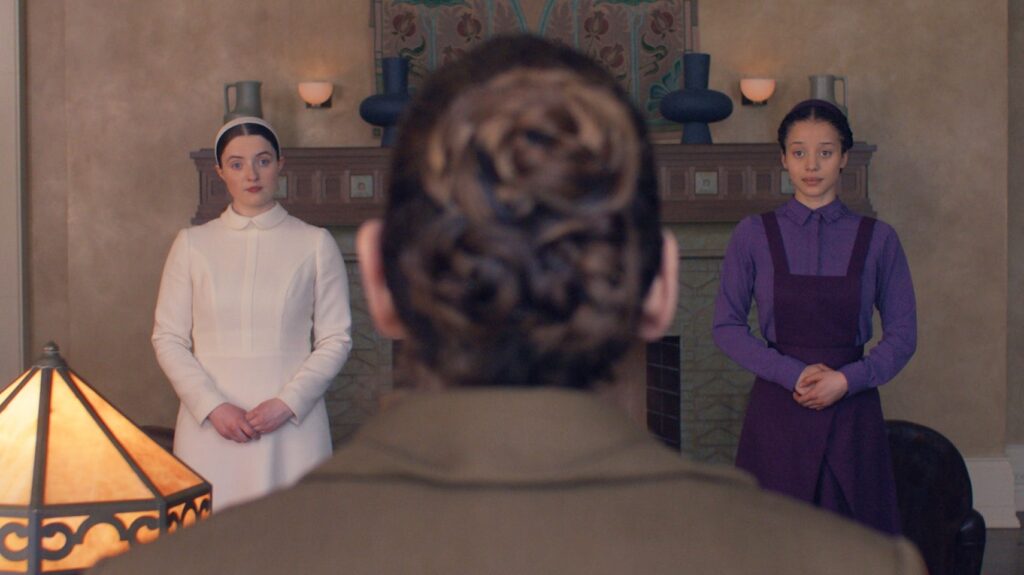
Still set in the pressure cooker of Gilead, although weaker in power than the prior series, the regime still continues its mission to create a traditional world with very conservative family values. The Testaments predominantly takes place at a preparatory academy headed by Aunt Lydia (still played by Ann Dowd). Action centers on Agnes Mackenzie (One Battle After Another’s Chase Infiniti), who is on her way to marrying her Commander, and new arrival Daisy (Lucy Halliday), who is training to become a disciplinary guardian called the Aunts. Agnes is chosen to look after Daisy and show her the ropes, and the two soon build the type of complicated kinship only seen between teenage girls.
The series follows the Aunts in training, the young girls set to marry commanders upon reaching womanhood, and the existing Aunts in the academy, who train the girls to become perfect wives in this archaic world. Daisy, as an outsider from Canada, can especially see how strange their regimented lives are, in which the whole existence of a woman is to be a wife and mother.
The show and its source novel memorably also act as a character study of Aunt Lydia. Helped by a powerhouse performance by Ann Dowd, Lydia is one of the most terrifying characters in recent literature and television, but The Testaments gave the audience context into her cruel actions. At the end of The Handmaid’s Tale, she became disillusioned with the hypocrisy of those in power and saw just how cruel their actions were. This series follows her in this state of mind, wrestling with Gilead’s morals and slowly realizing the Commanders are not who she thinks they are.
Lydia gets her own well-timed flashback episode, finally giving some context to her cruel behavior. It’s by far a series highlight, but it has nowhere near the punch of the source material. Fans of Atwood’s book may be disappointed in the lack of Lydia here, who plays a much bigger role in the source material. It’s clear the writers are hoping The Testaments goes on for more series, where they can add even more backstory to Lydia and her fellow Aunt Vidala (Mabel Li), exploring some of the book’s more shocking moments.
A Younger Take on The Handmaid’s Tale
The Testaments feels like it’s made for a younger audience than The Handmaid’s Tale, acting more like a coming-of-age story than a dystopian nightmare. Fans of the original show may find some moments here too YA for them and lacking the grit of Moss’ series. It’s certainly a good entry point for younger audiences who missed out on the original show.
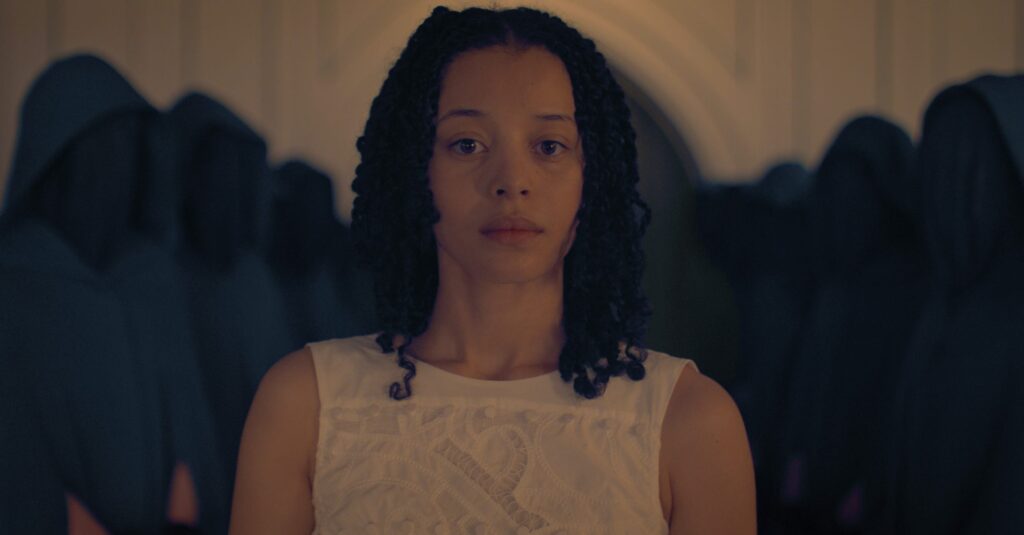
The show initially looks brighter with sugary pastel tones, but becomes darker throughout the series, as the rose-tinted glasses fall off our protagonists. The series loses its whimsy as the women learn the truth about being a woman in Gilead. What starts as frothy YA ends in a much darker place, as the young Commander’s wives learn to stand up for themselves, having seen through the smoke and mirrors.
If you were concerned that Elizabeth Moss would be missed from the show, fear not. British actress Lucy Halliday is a triumph and is sure to have a huge career ahead. She attacks the role with the same ferocity as Moss, staring down the career with a similar chilling menace. Chase Infinity also continues her run as the sweeter Agnes, all doe-eyed and innocent, a total antithesis of her role in the Oscar-winning One Battle After Another. All the young actresses here are incredible talents, not just the leading duo. Mattea Conforti and Rowan Blanchard both stand out from the ensemble for their roles as girls who go on a journey of realization about what being a woman in Gilead entails.
A Show Which Suffers From Style Over Substance
Set over eight episodes, the show’s pacing suffers. There are a few episodes that could have been merged, and some elements drawn out for too long. While the aesthetics are beautiful, there is a frustration that minutes from the episode are dedicated to watching cakes being made and girls getting ready to meet their prospective husbands. The whimsy might be a little too wasteful for some.
When the show focuses on the characters and expands their world, it’s enigmatic, chilling, and thrilling, but too much time is spent on making mini music videos. You’ll be forgiven for zoning out during an extended montage that sees parties planned, dinner tables set, and hair brushed. But don’t worry, there is enough to grab back your focus, especially in the last three episodes.
The Testaments has all the ingredients needed and a lot of great moments, yet it is weighed down by fluff. The first half feels very junior and twee, but once it sinks into the grit, you’ll want more. These ten episodes still very much feel like the foundations to something more, something bigger than hasn’t yet been reached.
An Underwhelming Adaptation Of A Great Atwood Novel
The Testaments is written from the perspectives of three women and is presented as an account of their experiences in a declining Gilead, and presented as part of research seminars. The TV show picks and chooses from the source material, although showrunner Bruce Miller hints that the upcoming series will explore the novel’s future timeline.
Perhaps the issue is The Testaments, unlike when The Handmaid’s Tale debuted in 2017, is just too relevant to be shocking anymore. Some of the attitudes displayed by Gilead aren’t that archaic or upsetting anymore, it’s like opening up social media any given day.
When The Testaments is good, it’s very good. But too much time is spent on pointless montages and stylish cutaways to achieve the impact intended. The Handmaid’s Tale had grit, it’s uncomfortable to watch, and will make you want to burn down the government bodies disenfranchising women. The Testaments gets nowhere close to that. If The Handmaid’s Tale is about how we reach dystopia, The Testaments is about how we get out of it.
The Testaments premieres April 8th on Disney+


![Peacemaker Episode 4,5 – Vigilante Comes Out To Play [Review]](https://www.thathashtagshow.com/wp-content/uploads/2022/01/271537705_678740953133676_7591709143099591335_n-440x264.png)
![Emergency Is A Thoughtful And Thrilling Genre Mash-Up [Sundance 2022 Review]](https://www.thathashtagshow.com/wp-content/uploads/2022/01/271713172_495794695516391_6755836795952022081_n-440x264.png)
![Avatar: The Way Of Water – An Absolute Technical Marvel [Review]](https://www.thathashtagshow.com/wp-content/uploads/2022/12/317909799_869500410745495_6749337006880904370_n-440x264.jpg)
 That Hashtag Show
