
![‘The Pitt’ S2 Episode 8 Recap: The ER Switches Over to Analog In An Old-School Twist [RECAP/REVIEW]](https://www.thathashtagshow.com/wp-content/uploads/2026/02/The-PItt-Review-2-1280x640.png)
At the end of last week’s episode of The Pitt, we finally learned what happened to cause Westbridge to shut down. As PTMC preemptively secures itself from a possible cyberattack, the younger doctors and nurses get a trial by fire on how their superiors did their jobs “in the 1900s.”
With their systems being shut off immediately, they all had to hope that Whitaker had managed to get a photo of the board in time. Though his attempt was heroic, the only thing Whitaker was able to do was take a shocked selfie and a very blurry picture of the board. Luckily for the ER, Kwon has a photographic memory and works with Al-Hashimi to get the information copied to the whiteboard.
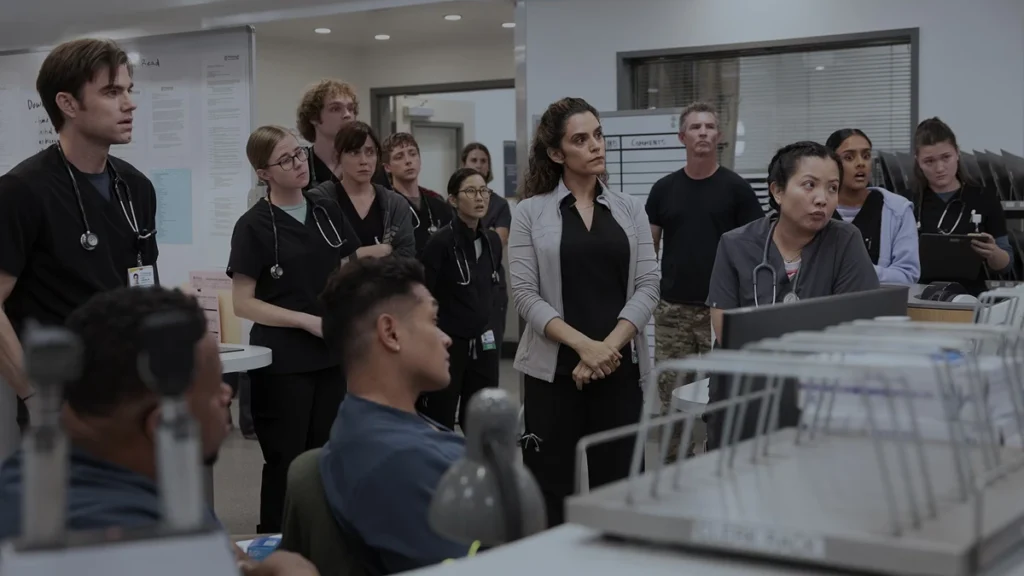
Meanwhile, Dana is still attending to Alana, meaning that Princess has to step up as charge nurse of the ER. Robby, Abbot, and Al-Hashimi give the room a crash course on things like triplicate lab orders, landline calls, fax machines, and chart organization, highlighting just how much technology now permeates the medical field. It certainly isn’t going to be easy for the younger staff to hard pivot into this new method, but they at least are in great company.
Despite this setback and forced adjustment, the ER takes it in stride. Sure, there are a few mishaps with felt-tip pins and incorrect charting, but the doctors and nurses take it in stride and keep the pace going. More patients keep streaming in, and the ER keeps moving like clockwork.
In many ways, this presents the perfect episode to get to live in with the doctors as they go about their duties. There aren’t any major medical emergencies requiring everybody’s attention; instead, we’re able to see how they do their best to provide a sense of normalcy for their patients. It’s an adjustment, not chaos.
New patients and patient updates
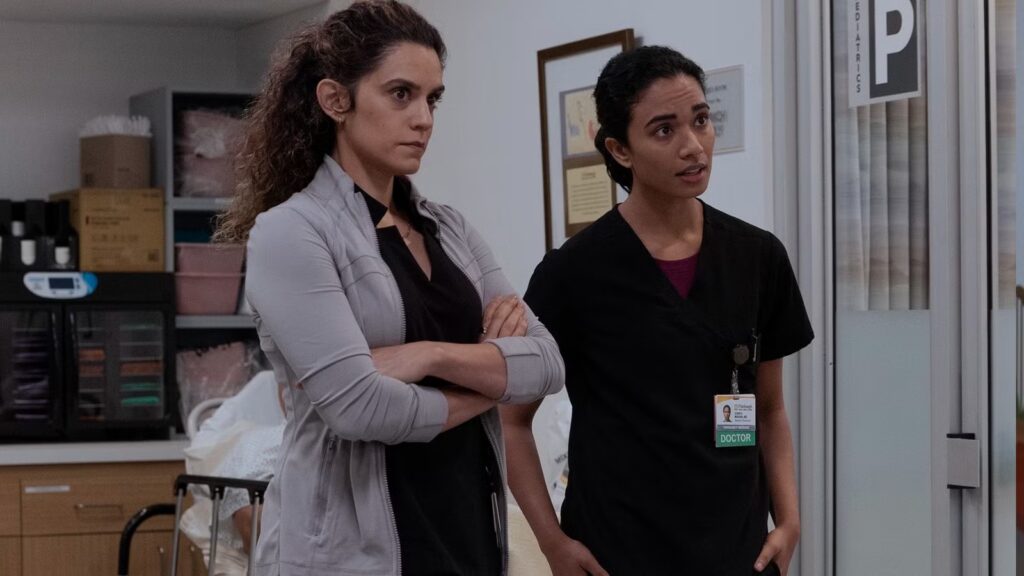
Harlow, Santos’s deaf patient, finally gets a diagnosis after a long, arduous process with interpreter issues, and Santos learns a lesson about waiting and listening to her patients instead of making knee-jerk decisions out of frustration. Though the work can be tedious at times, it’s better to wait to make sure that the decision you’re making benefits the patient, not just you.
While Santos is learning a lesson, Ogilvie seemingly is not, or is at least learning one very slowly. Howard, a patient whose weight of 474 complicates his case of abdominal pain and fever, is brought in. Instead of treating him like any other patient, Ogilvie makes continuous comments about his weight while expressing no empathy.
Luckily, McKay talks to him and reminds him that their job is about treating people with respect. Let’s hope he learns that sooner rather than later. Howard’s weight may make things more difficult, but he’s still a person with feelings. He deserves the same care as anybody else. I’m glad to see The Pitt continue taking an anti-fatphobia stance in healthcare, because too often those patients are dismissed due to their weight when something is actually wrong.
“2:00 P.M.” also gives us an update on Jackson. Psych finally figures out that he’s most likely suffering from either bipolar disorder or schizophrenia. It’s obviously tough to hear for his parents, but patient support advocate Nicole Steadman gently advises them on their new reality. Her daughter was diagnosed with schizophrenia at 20, she said. Though there are good days and bad days, there is also still love. Jackson’s parents are still processing, but they hold onto every word.
We should let Dana yell at everybody about everything
Now that Alana’s collection is complete, Dana can add the rape kit to the fridge for detective pickup. But when she opens the door, she sees another problem: The kits are supposed to be picked up within 72 hours, but there is one still sitting in there that is over two weeks old. I’m not saying it was really satisfying hearing Dana chew out the police over the phone, but it was really satisfying.
Mohan and Al-Hashimi chat about Mohan’s fellowship options now that she doesn’t have to apply in New Jersey. Mohan toses out ultrasound, toxicology, or sports medicine. Al-Hashimi suggests geriatrics as an option. From what we have seen of past interactions, Mohan is incredibly patient and gentle, especially with her former blood clot patient. It’s clear he’s dealing with medical-induced anxiety, but Mohan always makes it a point to listen.
It’s impressive at how quickly PTMC adjusts to their new normal. The real question is: Will it last?
For more Reviews, make sure to check back to That Hashtag Show.



 That Hashtag Show
